
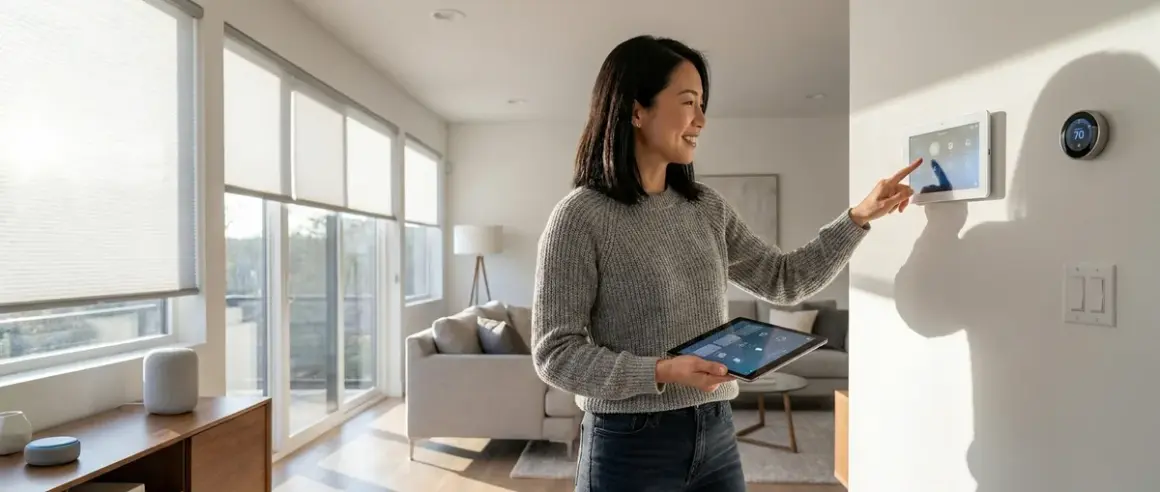

A thoughtfully designed smart home tour reveals how automation can enhance daily life without visual intrusion—where technology recedes into architecture and routines unfold as if by instinct. The best smart home implementations disappear completely, leaving only comfort, efficiency, and the quiet satisfaction of spaces that anticipate your needs before you articulate them.
This smart home tour walks through ten distinct spaces where protocol choices, sensor placement, and automation logic create environments that respond to presence, time, and context. Each room demonstrates how invisible intelligence transforms ordinary moments—morning light that shifts with circadian rhythms, climate that adjusts to occupancy, security that activates without conscious thought.
The Entryway: Presence Detection That Orchestrates Arrival
The front door becomes a trigger point for cascading automations when equipped with Zigbee contact sensors paired with mmWave presence detection mounted discreetly above the door frame. Unlike PIR motion sensors that require movement, mmWave radar detects stationary presence and breathing patterns, distinguishing between a package left on the porch and a person standing still while fumbling with keys.
This space demonstrates multipoint logic essential to starting a smart home from scratch: IF door contact sensor opens AND mmWave detects presence AND time is after sunset, THEN activate entryway lighting at 40% brightness and disarm security system. The automation waits three seconds after door contact to prevent false triggers from wind. When the mmWave sensor confirms no presence for 90 seconds after the door closes, lighting fades over ten seconds and the system rearms. Protocol choice matters here—Zigbee sensors offer 50-80ms latency on battery power, while Wi-Fi alternatives drain batteries in weeks rather than months and introduce 200-400ms delays that make lighting feel sluggish.
Invisible Alternative: Mount the contact sensor inside the door frame channel and the mmWave sensor in the ceiling plenum with only a tiny lens visible through a drilled hole, or integrate it into a smoke detector housing.
The Living Room: Adaptive Lighting That Follows Circadian Rhythms
Recessed lighting controlled by Matter-compatible smart switches provides the foundation, but the intelligence lives in color temperature automation that shifts from 2700K warm white in evening to 4000K neutral in late morning. The Philips Hue White Ambiance Recessed Downlight demonstrates this principle, though any Matter tunable white fixture achieves the same result without the Hue ecosystem overhead.
Here's how time-based automation intersects with occupancy awareness: IF time equals sunrise, THEN transition from off to 2700K at 10% brightness over 30 minutes. IF mmWave presence detected AND time between 10 AM–2 PM, THEN shift to 4000K at 60% brightness. The gradual transitions prevent the jarring sensation of sudden color shifts—each change occurs over 8–12 minutes, imperceptible in real time but profound over hours. The system maintains last-used brightness when manual adjustments occur, pausing automation for two hours before resuming the circadian schedule.
Reliability factors: Matter ensures interoperability between hubs, but as of 2026, color temperature control remains inconsistent across platforms—some report only on/off states, requiring custom polling every five minutes to sync status. Fallback behavior reverts to last known state if hub connectivity drops, which means fixtures default to their previous brightness and temperature rather than losing all settings.
Invisible Alternative: Install tunable white fixtures in standard recessed cans so no visible hardware differs from conventional lighting, with switches flush-mounted in wall plates indistinguishable from standard toggles.
The Kitchen: Multi-Sensor Triggers for Contextual Automation
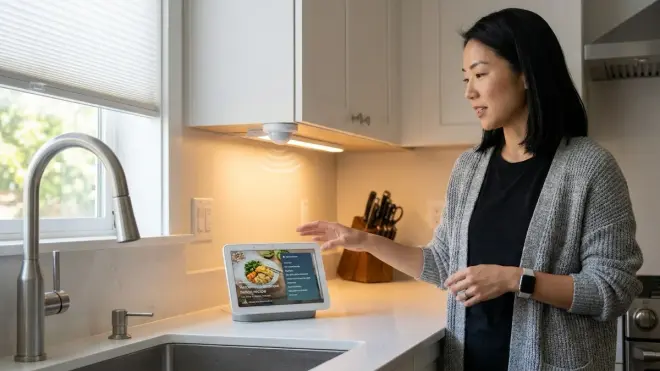
The kitchen reveals the complexity behind seemingly simple automations. Thread-enabled contact sensors on cabinet doors, Zigbee temperature/humidity sensors near the range, and a mmWave ceiling sensor create a decision tree that responds to cooking activity: IF cabinet sensors open twice within 60 seconds AND mmWave detects presence near range AND humidity rises 15% in 90 seconds, THEN activate range hood to medium speed and increase under-cabinet task lighting to 80% brightness.
Why does this work when single triggers don't? Opening a cabinet for a glass doesn't require the hood, but multiple conditions create context-aware responses. The Thread protocol offers sub-50ms latency and mesh reliability superior to Zigbee in environments with dense Wi-Fi interference from microwaves and routers. When cooking ends (humidity drops below baseline for eight minutes AND no motion detected), the hood runs for an additional three minutes to clear residual steam, then powers down.
Compatibility requirements: Thread sensors require a border router (HomePod mini, Google Nest Hub 2nd gen, or dedicated Thread border router) to bridge to Wi-Fi networks where hub controllers reside. The smart home setup checklist details these infrastructure dependencies that trip up single-device purchases.
Invisible Alternative: Recess contact sensors into cabinet hinge channels, mount temperature/humidity sensors behind decorative kick plates with ventilation holes, and embed mmWave in ceiling drywall with only a 6mm sensor lens visible through paint.
The Home Office: Presence-Aware Climate and Lighting Zones
A ceiling-mounted mmWave presence sensor (5.8 GHz, not the 24 GHz variants that penetrate walls and trigger from adjacent rooms) creates a distinct automation zone: IF presence detected AND time between 8 AM–6 PM, THEN set desk lamp to 4500K at 70% brightness and adjust thermostat setpoint to 71°F. IF no presence for 15 minutes, THEN dim lamp to 20% and return climate to away mode.
This room demonstrates zone-based automation often missing from basic smart home tours—rather than whole-home climate schedules, individual rooms respond to actual occupancy. The mmWave sensor's ability to detect typing or stillness prevents the frustration of PIR motion sensors that require arm-waving every ten minutes during focused work. Z-Wave thermostats (SoC 700 or 800 series) respond to commands within 100-200ms, but physical temperature changes lag 3-5 minutes due to HVAC system inertia.
Interoperability limitations: As of 2026, Matter thermostats still lack standardized scheduling features—each manufacturer implements proprietary time-of-day programming that doesn't transfer between ecosystems. Automation must live in the hub, not the thermostat firmware, to maintain portability.
Invisible Alternative: Position the mmWave sensor in an air return vent grille or integrate it into a ceiling-mounted smoke detector housing, with desk lamps using tunable white LED strips concealed in monitor backlights or desk undercuts.
The Bedroom: Wake and Sleep Routines Without Buttons
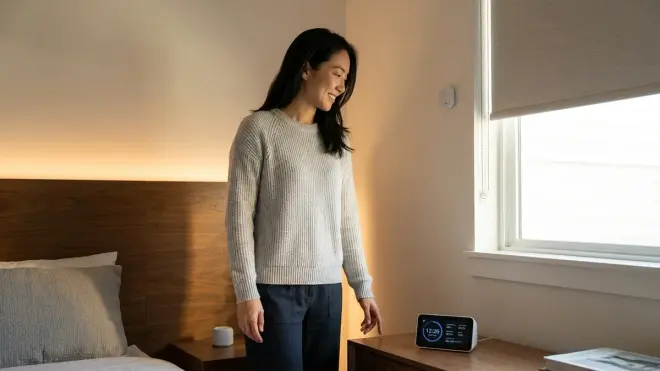
Bedroom automation succeeds when it requires zero conscious input. A Zigbee bedside motion sensor angled to detect feet hitting floor (not rolling over in bed) triggers morning routines: IF motion detected AND time between 5 AM–8 AM AND bedroom contact sensor closed (door still shut), THEN begin lighting fade-in from 0% to 30% over five minutes at 2200K amber, start coffee maker via Z-Wave smart plug, and pause security motion detection in hallway for 90 seconds.
This space demonstrates negative space automation—the absence of certain conditions matters as much as presence. The door contact sensor prevents the routine from triggering if someone's already awake and closed the door for a napping partner. Coffee timing uses a predictive offset: the routine sends the plug activation command at motion detection, knowing the Z-Wave mesh introduces 80-150ms latency and the coffee maker requires three minutes to brew, syncing completion with the end of the lighting fade.
Fallback behavior: If hub connectivity fails, the Zigbee sensor stores up to 500 events locally and the Z-Wave plug maintains last state, meaning coffee won't auto-brew until connectivity restores, but lights won't suddenly activate at 2 AM from a firmware bug.
Invisible Alternative: Mount the motion sensor inside a nightstand with a small PIR lens window, or embed it in a picture frame aimed at the floor space where feet land.
The Bathroom: Humidity-Reactive Ventilation and Safety Lighting
The bathroom requires dual-input automation for exhaust fan control: IF humidity rises 20% above baseline OR shower door contact sensor opens, THEN activate exhaust fan to high speed. IF humidity returns to baseline +5% for four consecutive minutes, THEN reduce to low speed for additional six minutes before powering off. This prevents premature shutoff while steam lingers.
The smart home energy management system integrates bathroom ventilation into whole-home humidity control, preventing the 60%+ humidity levels that encourage mildew growth. Night lighting uses the same mmWave presence detection as other rooms, but dims to 2% brightness at 2000K to preserve night vision: IF presence detected AND time between 10 PM–6 AM, THEN activate lighting at 2% for 120 seconds, extending timer with continued presence.
Protocol choice: Zigbee humidity sensors report readings every 30-60 seconds, adequate for shower detection but too slow for leak monitoring, which requires Wi-Fi sensors with 5-second polling intervals despite higher power consumption.
Invisible Alternative: Recess humidity sensors into medicine cabinet backs, use contact sensors inside shower door frames, and replace standard exhaust fan grilles with smart variants that look identical to conventional ones.
The Hallway: Directional Motion Detection for Context-Aware Lighting

Hallway automation demonstrates how sensor placement geometry creates directional awareness. Two PIR motion sensors positioned at opposite ends, combined with time-delta analysis, determine travel direction: IF sensor A triggers THEN sensor B triggers within three seconds, direction equals toward bedrooms. IF sensor B triggers THEN sensor A triggers within three seconds, direction equals toward living areas.
Direction determines automation response: IF direction equals toward bedrooms AND time after 9 PM, THEN activate hallway lighting at 15% warm white to preserve sleep readiness. IF direction equals toward living areas AND time before 8 AM, THEN activate at 40% neutral white for wakefulness. Single-sensor triggers (walking partway down hall then reversing) fade lighting over ten seconds rather than immediate shutoff, preventing the disorienting darkness of too-aggressive timeouts.
This sequence reveals the logic depth possible when installing first smart home devices with intentional placement. Zigbee PIR sensors work well here because hallways have clear sight lines—the 110° detection angle covers width, and battery life extends 18-24 months on CR2450 cells. Matter support remains incomplete for motion sensors as of 2026, with most manufacturers offering only basic presence/no-presence states without granular sensitivity tuning.
Invisible Alternative: Recess PIR sensors into air return vents at baseboard level, or use pinhole sensors mounted in ceiling crown molding with lenses barely visible from floor level.
The Media Room: Activity-Based Scene Automation
The media room demonstrates multi-device scene coordination: IF Apple TV powers on (detected via HDMI-CEC through TV's Matter integration), THEN dim overhead lighting to 5%, close motorized blackout shades (Z-Wave motors), and switch floor lamp to bias lighting mode at 10% 6500K behind screen. Power-off reverses the sequence over 30 seconds.
This space reveals the interoperability challenges honest smart home tours must address—HDMI-CEC (Consumer Electronics Control) varies wildly by TV manufacturer. Samsung and LG implement it reliably as of 2026, while budget brands send inconsistent signals or none at all. Fallback requires either IR blasters pointed at equipment (visually intrusive) or Wi-Fi plugs with power monitoring that detect the 40-80W increase when Apple TV activates, though this introduces 2-3 second delays that make automation feel reactive rather than instant.
Shade compatibility demands explicit checking: Z-Wave motorized shade controllers from different manufacturers (Somfy vs. Bali vs. IKEA FYRTUR) use incompatible mounting hardware despite running the same protocol. Mixing brands within a room creates mismatched operation speeds and calibration drift.
Invisible Alternative: Install blackout cellular shades in side channels so fully-closed position shows no visible motor hardware, recess bias lighting LED strips behind TV frame, and use ceiling fixtures with integrated dimming modules that require no external boxes.
The Garage: Multi-Conditional Security Integration
Garage automation balances convenience with security through stacked conditional logic: IF garage door opener activates AND time between 10 PM–6 AM, THEN send notification to phones and activate driveway camera recording with motion spotlight. IF garage door remains open longer than eight minutes AND any household member's phone geofence indicates away status, THEN send escalating notifications at 8, 15, and 30 minutes, and auto-close at 35 minutes if still open.
Most multi-protocol smart home hubs handle geofencing integration inconsistently. iOS location services drain battery 15-20% faster when precision geofencing runs continuously, while Android varies by manufacturer—Samsung phones handle it efficiently, while budget variants poll location every 30 seconds. Geofencing fails in underground parking structures where GPS signal drops, requiring manual override routines that don't depend on phone presence.
The opener itself requires Wi-Fi connectivity (most use proprietary protocols rather than Zigbee/Z-Wave) or retrofitting with Z-Wave relay controllers wired to existing openers' wall switch terminals—a modification that voids warranties on openers manufactured after 2023 due to UL safety certifications.
Invisible Alternative: Replace visible Wi-Fi garage controllers with Z-Wave relay modules mounted inside the opener housing, use magnetic contact sensors painted to match door color, and position cameras in eave soffits rather than exposed wall mounts.
The Outdoor Perimeter: Weather-Integrated Lighting and Irrigation
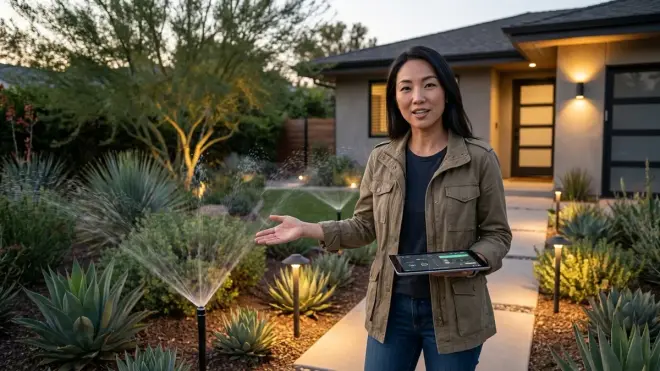
Outdoor automation demonstrates API integration with weather services: IF sunset time retrieved from NOAA service, THEN activate pathway lighting 15 minutes before sunset at 30% brightness. IF weather API reports precipitation probability above 60% within next 12 hours, THEN cancel scheduled irrigation run and reschedule for next clear window.
This final stop reveals dependency chains that create fragility—cloud API failures (NOAA data outages, rate limiting, changed authentication) break automations silently. Best practice requires dual fallback logic: IF weather API unreachable for 2 consecutive polls, THEN revert to time-based schedule using historical average for that date. The smart irrigation controllers with weather integration detail how local weather station data via Ambient Weather PWS provides offline weather awareness.
Pathway lighting uses Z-Wave or Zigbee outdoor modules (IP65 rated minimum) but protocol choice creates range challenges—metal siding and brick construction block signals, requiring mesh repeaters every 30-40 feet. Matter promised unified outdoor device support but as of 2026 still lacks standardized device classes for irrigation valves, leaving smart home power monitoring as the only cross-platform way to detect valve activation through current draw.
Invisible Alternative: Install pathway lighting in flush bollards that sit level with landscaping, bury Zigbee repeaters in weatherproof junction boxes under mulch near shrubs, and use subterranean valve boxes that hide all irrigation controllers.
How We Made Our Picks
These ten spaces were selected to demonstrate the architectural integration principles I've developed across hundreds of residential projects—technology that recedes until only its effects remain visible. Each room represents a distinct automation pattern: single-input triggers, multi-conditional logic, time-based sequences, API integrations, and zone-based climate control.
The selection prioritizes protocol diversity to show real-world mixing rather than single-ecosystem purity. Zigbee dominates battery-powered sensors for its longevity (18-24 months typical), Z-Wave handles high-reliability switching and climate control with mesh stability superior in dense construction, Thread offers the lowest latency for upcoming devices, and Matter provides interoperability where mature (lighting, switches) while remaining inconsistent elsewhere (thermostats, sensors).
Spaces were chosen to reveal honest limitations that generic smart home tours omit: geofencing battery drain, HDMI-CEC inconsistency, Matter's incomplete sensor support, and cloud API fragility. The goal is informed purchasing—understanding compatibility requirements, latency expectations, and fallback behaviors before investing in devices that may not integrate as promised.
Each example includes invisible installation alternatives because aesthetic integration determines whether automation feels intrusive or natural. Exposed sensors and wall warts undermine the spatial serenity that makes technology worth integrating in the first place.
Frequently Asked Questions
What protocols should I prioritize when building a smart home in 2026?
Zigbee for battery-powered sensors (contact, motion, temperature/humidity) due to 18-24 month battery life and wide device selection, Z-Wave for line-powered devices (switches, plugs, thermostats) requiring mesh reliability through concrete and metal, and Matter for lighting and switches where cross-platform compatibility matters most—with the understanding that Matter sensor support remains incomplete and many device classes still require proprietary protocols.
How do I make smart home devices visually disappear into my home?
Recess sensors into existing architectural elements—mount contact sensors inside door frame channels, embed PIR sensors in baseboard air returns or ceiling crown molding, and use in-wall relay modules behind standard switches rather than replacing wall plates with oversized touchscreens. Choose tunable white recessed fixtures over colored bulbs, flush-mount junction boxes over surface conduit, and devices in finishes matching your wall colors rather than accepting manufacturer default white plastic.
What causes smart home automations to feel sluggish or unreliable?
Wi-Fi devices add 200-400ms latency compared to Zigbee/Z-Wave's 50-150ms due to network authentication overhead, weak mesh coverage creates retry delays when signals can't reach the hub in one hop, cloud dependencies introduce variable latency when local processing would respond instantly, and poorly written conditional logic waits for multiple sensor confirmations before acting—each adding 2-5 seconds of perceived delay that makes automation feel reactive rather than anticipatory.
Can I mix different smart home ecosystems or must everything match?
You can mix ecosystems but must run automation logic through a hub that speaks multiple protocols—Home Assistant, Hubitat, or SmartThings—rather than relying on individual ecosystems' native apps. Matter devices theoretically work across platforms but as of 2026 advanced features often require staying within one ecosystem (Hue scenes only fully function in Hue app, Aqara sensors lose sensitivity tuning outside Aqara hub), and proprietary devices (Lutron Caseta, IKEA FYRTUR) require their dedicated bridges that then connect to your central hub.
Final Thoughts
The most successful smart home tour doesn't showcase technology—it reveals spaces that feel intuitively responsive, where lighting anticipates your needs, climate adjusts to presence, and security activates without conscious thought. The intelligence should be felt in the rhythm of your day, the comfort of rooms that prepare themselves for your arrival, and the quiet confidence that systems will behave predictably even when networks fail.
Invisible integration demands more planning than plugging in visible gadgets. Sensor placement geometry determines whether directional detection works. Protocol selection affects battery life, latency, and reliability through your home's specific construction materials. Conditional logic depth separates automation that feels magical from sequences that trigger at wrong moments.
But when technology finally disappears—when you stop thinking about switches and sensors and simply live in spaces that respond—that's when smart home implementation succeeds. The goal isn't showcasing what your home can do. It's forgetting the technology exists at all.