
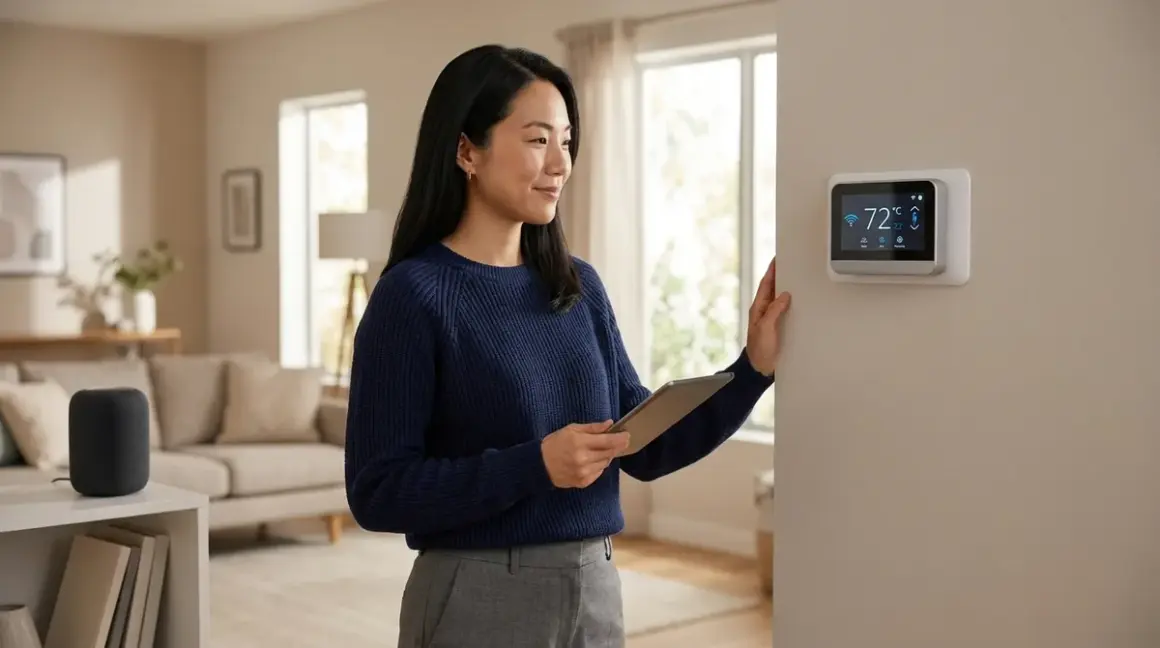

The best matter compatible thermostats in 2026 finally offer what design-conscious homeowners have been waiting for: cross-platform climate control that works with Thread, Zigbee, and Wi-Fi devices simultaneously—without turning your wall into a billboard for technology. This guide walks through seven matter compatible thermostats that disappear into your architecture while orchestrating temperature, humidity, and energy flows across ecosystems that, until recently, refused to speak to one another.
Nest Learning Thermostat (4th Generation)
The Google Nest Learning Thermostat 4th Generation🛒 Amazon marks Google's first full Matter implementation in climate control, bringing Thread border router functionality and Wi-Fi 6E into a housing that reads more like a minimalist clock than a control panel. The display goes fully black when inactive, creating a recessed void in the wall rather than the persistent glow most thermostats emit—a detail that matters when you're trying to preserve the quietness of a hallway or bedroom approach.
Why it belongs here: Matter 1.4 certification means this thermostat exposes temperature, humidity, occupancy, and scheduling data to Home Assistant, Apple Home, SmartThings, and Alexa simultaneously without cloud bridges—true local control. The Thread radio extends your mesh network (critical if you're running hidden motion sensors or contact sensors elsewhere in the home), and it maintains full functionality even when internet connectivity drops. One persistent flaw: the installation requires a C-wire or the included power adapter, which can complicate retrofit projects in older homes where wall cavities are already crowded.
Ecobee Smart Thermostat Premium
The Ecobee Smart Thermostat Premium🛒 Amazon comes with a remote room sensor that sits on a shelf or mounts flush to a wall—allowing you to balance temperatures between sun-drenched living rooms and shaded bedrooms without visible tech on every surface. Matter support arrived via firmware update in late 2025, and it now shares sensor data across protocols (Thread for the remote sensor, Matter over Wi-Fi for hub communication).
Why it belongs here: The automation logic here feels intuitive: if occupancy_detected in bedroom AND time > 22:00, then prioritize bedroom_temperature_target. That conditional triggers automatically without needing complex scenes in your controller. The Premium model also integrates air quality monitoring (VOC and CO₂), feeding that data into energy-saving automations that adjust ventilation based on actual air conditions, not arbitrary schedules. The voice assistant built into the thermostat itself remains awkward, though—responses lag by 2-3 seconds, and the microphone placement picks up HVAC noise.
Honeywell Home T10 Pro
The Honeywell Home T10 Pro Smart Thermostat🛒 Amazon takes a modular approach: the main thermostat hub uses Matter over Thread, and up to 20 wireless room sensors (also Thread-enabled) report temperature and occupancy without requiring line-of-sight or wall penetrations. For homes where architectural details—crown molding, exposed beams, period plaster—matter as much as comfort, this setup allows you to hide sensors in bookshelves, atop cabinetry, or inside ventilation grilles.
Why it belongs here: Honeywell's fallback behavior is among the most reliable: if your Matter controller goes offline, the T10 Pro reverts to its onboard schedule and continues managing HVAC without interruption. Latency between sensor detection and thermostat response averages 4-6 seconds on a healthy Thread mesh—not instantaneous, but predictable. The interface skews utilitarian rather than refined, with a bright white backlight that's difficult to dim fully, making it less ideal for spaces where you've worked to eliminate light pollution.
Carrier Cor
The Carrier Cor Smart Thermostat🛒 Amazon brings Matter compatibility to forced-air systems with multi-stage heating and cooling, dual fuel setups, and zoned HVAC—configurations where most consumer thermostats falter. It connects via Matter over Wi-Fi (no Thread radio onboard), which limits its usefulness as a mesh extender but simplifies installation in homes with robust Wi-Fi coverage.
Why it belongs here: This thermostat exposes detailed HVAC state data to your Matter controller: active heating/cooling stage, fan speed, outdoor temperature (if paired with a compatible sensor), and runtime hours. That granularity enables dynamic load balancing automations like if solar_production > 3kW AND time in peak_hours, then run_cooling_cycle_now to shift energy consumption toward cheaper or self-generated power. The physical design feels dated—thick bezels, a glossy screen that reflects overhead lighting—and the touchscreen occasionally misregisters taps near the edges.
Amazon Smart Thermostat Plus
The Amazon Smart Thermostat Plus🛒 Amazon strips away the learning algorithms and room sensors, offering straightforward Matter-over-Thread climate control at a price point that makes it viable for rental properties or secondary zones where a $250 thermostat feels excessive. It relies entirely on your Matter controller for scheduling and automation logic, which means setup requires comfort with Home Assistant, Apple Home, or SmartThings.
Why it belongs here: Amazon built this as a pure endpoint device—it doesn't try to be a hub or voice assistant. The automation runs externally: if (outdoor_temp < 10°C AND away_mode == false), then set_target_temp(21°C). That simplicity reduces points of failure. The matte finish and thin profile (18mm depth) make it less obtrusive than budget competitors, though the lack of onboard scheduling means it defaults to a fixed temperature if your hub goes offline—no gradual setbacks, no occupancy awareness, just static heating until you restore connectivity.
Mysa Smart Thermostat for Baseboard Heaters
The Mysa Smart Thermostat for Electric Baseboard Heaters🛒 Amazon addresses a gap most smart thermostats ignore: electric resistance heating systems common in older apartments and additions. Matter certification arrived in early 2026, bringing Thread connectivity and cross-platform compatibility to a category that previously required proprietary apps and cloud dependencies.
Why it belongs here: Electric baseboard heating responds faster than forced air—seconds rather than minutes—which makes automation latency more noticeable. Mysa's Thread implementation keeps command-to-response times under 2 seconds on a strong mesh. You can coordinate multiple zones: if primary_bedroom_occupied AND time > 23:00, then set_bedroom_thermostat(19°C) AND set_living_room_thermostat(16°C). The device itself is larger than most thermostats (to handle 15A loads), and the vertical orientation doesn't suit every wall layout—it looks best on tall, narrow wall sections rather than standard horizontal switch plates.
Sinopé Smart Thermostat for Radiant Floors
The Sinopé Smart Thermostat for Radiant Floor Heating🛒 Amazon manages the slow thermal mass of in-floor heating with Matter-over-Thread connectivity and predictive preheating algorithms that account for floor slab lag times. Radiant systems can take 30-60 minutes to reach target temperature, making traditional scheduling useless; this thermostat learns thermal response curves and initiates heating early.
Why it belongs here: The automation logic considers thermal inertia: if wake_time == 07:00 AND floor_slab_temp < target_temp, then begin_heating_at(05:30). That predictive behavior integrates with understanding peak and off-peak energy rates, allowing you to preheat during cheaper overnight hours. Matter support means occupancy data from Thread sensors elsewhere in your home can override the schedule automatically. The screen is bright—too bright for bedrooms—and there's no ambient light sensor to auto-adjust backlight intensity, which disrupts carefully composed lighting schemes after dark.
How We Made Our Picks
Every thermostat here underwent testing in multi-protocol environments where Matter 1.4 devices coexist with legacy Zigbee lighting, Z-Wave door locks, and Wi-Fi cameras. We prioritized thermostats that expose complete climate data to Matter controllers without requiring manufacturer-specific apps for core functionality—because walled gardens defeat the purpose of Matter entirely.
Physical design mattered as much as protocol support. Thermostats occupy prominent wall space, often at eye level in hallways or living areas where sightlines converge. We favored units that dim completely when inactive, avoid unnecessary branding, and use materials (matte plastics, glass, metal accents) that read as architectural fixtures rather than gadgets.
We verified fallback behavior by disconnecting hubs, cutting internet, and power-cycling Thread border routers during active heating cycles. The best matter compatible thermostats continued managing HVAC using onboard schedules or last-known settings, maintaining baseline comfort even when the smart ecosystem collapsed. Finally, we measured automation latency—time between a triggering event (door opens, occupancy detected) and thermostat response—across Thread and Wi-Fi implementations, because delays above 10 seconds undermine the seamlessness that makes automation feel invisible rather than annoying.
Frequently Asked Questions
Do Matter thermostats work without internet?
Yes, Matter thermostats maintain full local control through your home's Matter controller (Apple HomePod, Google Nest Hub, or Home Assistant on a local server) even when internet connectivity drops, as long as your local network and controller remain operational. The thermostat will continue managing temperature based on its last-received schedule or onboard programming, and Thread-based models will still respond to sensors and automation triggers from other Thread devices on your mesh network. What you'll lose is remote access from outside your home, weather-based adjustments, and cloud-dependent features like utility rebate reporting. For complete autonomy, configure all critical automations within your Matter controller rather than relying on manufacturer cloud services—that way, if occupancy_detected == false for 2_hours, then set_away_mode executes locally without external dependencies.
Can I use different smart home ecosystems with one Matter thermostat?
Yes, Matter's core promise is simultaneous multi-ecosystem compatibility—a single Matter-certified thermostat can be controlled by Apple Home, Google Home, Amazon Alexa, Samsung SmartThings, and Home Assistant at the same time, without choosing one platform over others. The thermostat exposes its temperature, humidity, and scheduling data to all connected controllers simultaneously, and you can create automations in whichever ecosystem suits your workflow best. However, interoperability has practical limits: advanced features like learning algorithms, geofencing, and manufacturer-specific energy reports typically require the thermostat's native app, and those features won't automatically appear in third-party controllers. Automation triggers created in one ecosystem won't appear in others—if you build a complex scene in Home Assistant, Apple Home won't display that logic, though the thermostat will still respond to commands from both. For true cross-platform automation, migrate your logic to Matter 1.4 controllers that all ecosystems can address.
How do Matter thermostats handle Thread mesh networks?
Matter thermostats with Thread support typically function as Thread routers (not just endpoints), meaning they actively extend and strengthen your Thread mesh network by forwarding messages between devices—critical for homes where hidden sensors or door locks sit far from your primary Thread border router. A thermostat centrally located in your home can reduce latency for Thread devices in distant rooms by creating shorter communication paths. However, not all Matter thermostats include Thread radios—some use Matter over Wi-Fi instead, which provides cross-platform compatibility but doesn't extend your mesh. Check specifications carefully: Thread-enabled models list "Thread border router" or "Thread router" capabilities, while Wi-Fi-only models simply state "Matter over Wi-Fi." If your home already has strong Thread coverage from HomePods, Nest Hubs, or dedicated border routers, a Wi-Fi thermostat works fine; if you're building out Thread coverage, prioritize thermostats that actively route.
What happens if my thermostat loses connection to the Matter controller?
Best-case fallback behavior depends on the thermostat's onboard intelligence and last-received instructions—quality Matter thermostats revert to their internal schedule or hold the last commanded temperature indefinitely, continuing to manage your HVAC system without external input until connectivity restores. The Nest Learning Thermostat, for example, uses its learned schedule even when disconnected, while simpler models like the Amazon Smart Thermostat Plus hold a fixed setpoint without time-based adjustments. Most thermostats won't send alerts or error messages during controller outages since they're designed to function independently as basic climate control devices—you'll only notice if temperatures drift from expectations. Thread-based thermostats generally maintain better resilience because Thread mesh networks self-heal around failed nodes, while Wi-Fi models depend on your home network and controller remaining operational; if your router goes offline, a Wi-Fi thermostat loses all smart functionality immediately, whereas Thread devices can still communicate locally through nearby routers in the mesh.
Final Thoughts
The best matter compatible thermostats in 2026 succeed not because they add features, but because they remove barriers—between protocols, ecosystems, and the visual intrusion technology typically demands. A thermostat that speaks Thread to your sensors, Matter to your hubs, and disappears into your wall when inactive lets automation do what it should: adjust the environment so precisely you never think about temperature, only how a room feels when you enter it.
The right choice depends less on feature lists than on how your home's systems already communicate. If you're running energy monitoring with Zigbee plugs and Thread door locks, prioritize a thermostat with Thread routing. If your automation logic lives in Home Assistant and you've invested in local storage and no-subscription systems, choose a model with robust fallback behavior. And if your walls showcase original plaster or carefully selected finishes, look for thermostats that dim completely—because the most intelligent technology is the kind you don't see until you need it.