
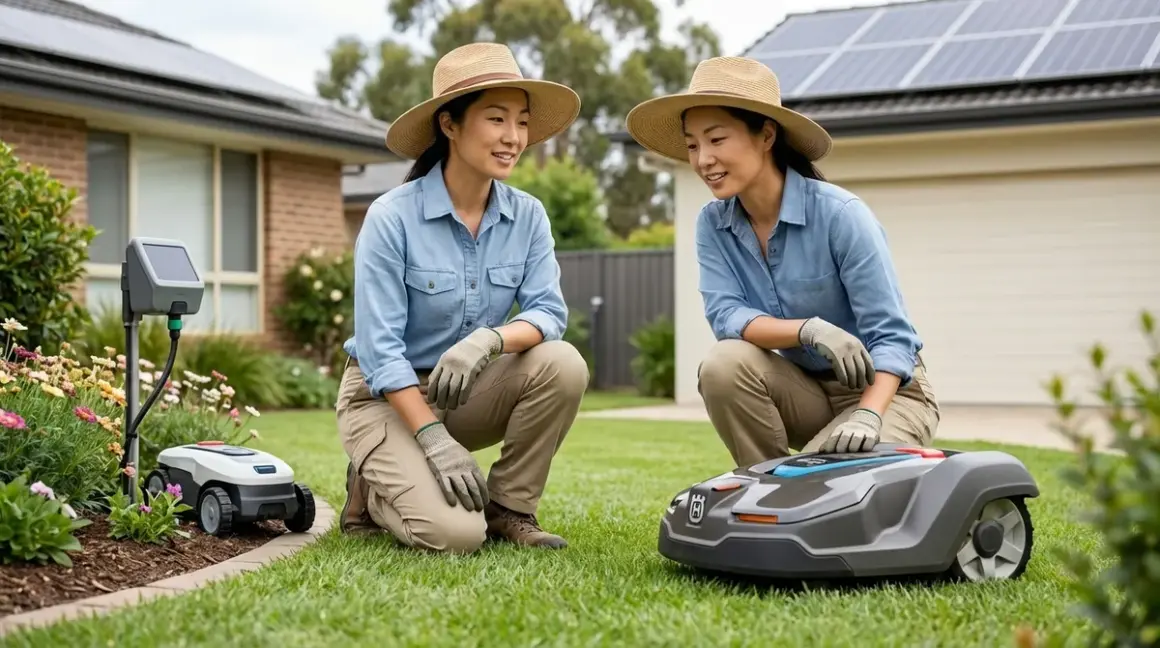

Your garden no longer needs you to thrive. What is autonomous landscaping technology? It's a network of interconnected devices—robotic mowers, smart irrigation controllers, soil sensors, and weather-aware lighting—that maintain outdoor spaces without manual intervention. Instead of weekend chores, you experience grounds that adjust to seasonal rhythms, water themselves during optimal windows, and adapt to microclimates you didn't know existed in your own yard.
This isn't about replacing the ritual of tending plants; it's about freeing you from the maintenance that dulls the pleasure of being outdoors. The technology fades into the landscape itself, leaving only the results: lawns that recover from summer stress before you notice the browning, beds that receive precisely calibrated moisture, pathways that illuminate as dusk settles without a single visible sensor.
What Is Autonomous Landscaping Technology?
Autonomous landscaping technology refers to a coordinated ecosystem of outdoor devices that use sensors, environmental data, and conditional logic to maintain landscapes with minimal human input. Unlike scheduled timers or manual tools, these systems make decisions based on real-time conditions—soil moisture, temperature, precipitation forecasts, growth patterns, and seasonal cycles.
The autonomy emerges from three layers working in concert. First, sensing infrastructure: moisture probes buried near root zones, weather stations that track hyperlocal conditions, cameras that monitor growth or detect pest activity. Second, actuating devices: robotic mowers that navigate boundaries, valve controllers that open irrigation zones, lighting systems that adjust intensity based on ambient conditions. Third, coordination logic: the hub or controller that interprets sensor data and executes rules you've established or the system has learned.
Most autonomous landscaping systems communicate via Wi-Fi, Zigbee, or proprietary mesh protocols. Robotic mowers typically use Wi-Fi for cloud connectivity and smartphone control, though some newer models are adopting Matter 1.4 for cross-platform compatibility. Smart irrigation controllers often rely on Wi-Fi to pull weather data from services like NOAA, while individual valve controllers may use Zigbee or Z-Wave to communicate with a central hub. Soil sensors vary widely—some transmit via sub-GHz radio frequencies with long range but limited data throughput, others use Bluetooth LE for short-range, battery-efficient communication with a nearby gateway.
The distinction between "smart" and "autonomous" matters. A timer-based sprinkler is smart if you can control it from your phone. It becomes autonomous when it skips a scheduled cycle because yesterday's rain left soil moisture above threshold, or when it extends a zone's runtime because temperature forecasts indicate higher evaporation rates. The shift from scheduled execution to conditional decision-making defines true autonomy.
In a typical residential deployment, the automation logic looks like this:
IF soil_moisture < 25% AND forecast_precipitation < 0.1_inches_next_24hrs AND time BETWEEN 4:00_AM AND 6:00_AM
  THEN open_zone_1_valve FOR calculated_duration
ELSE
  log_skip_reason AND retry_next_cycle
This isn't theoretical. Controllers from manufacturers like Rachio and Rain Bird implement these conditionals explicitly, allowing you to set thresholds, define weather dependencies, and establish fallback behaviors when sensor data becomes unavailable.
How Autonomous Landscaping Technology Works
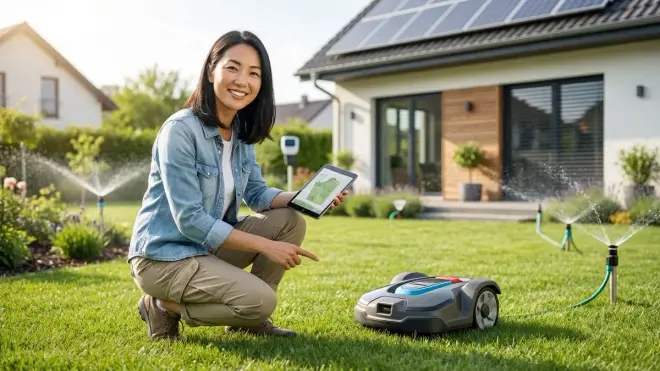
The mechanics begin with data collection distributed across the landscape. Soil moisture sensors—typically capacitive probes resistant to corrosion—measure volumetric water content at multiple depths. These devices transmit readings every 15 to 60 minutes, depending on battery capacity and protocol efficiency. A sensor using Zigbee in a mesh network might report every 20 minutes with years of battery life; a Wi-Fi sensor with more frequent updates may require annual battery replacement or hardwired power.
Weather integration provides the predictive layer. Smart irrigation controllers subscribe to hyperlocal forecast APIs, typically refreshing data every hour. When a controller detects incoming precipitation, it calculates whether the expected volume justifies canceling scheduled cycles. More sophisticated systems adjust not just for rain, but for wind speed (which accelerates evapotranspiration), humidity, and solar radiation. The Rachio 3 exemplifies this approach, combining onsite sensors with regional weather models to build irrigation schedules that shift daily.
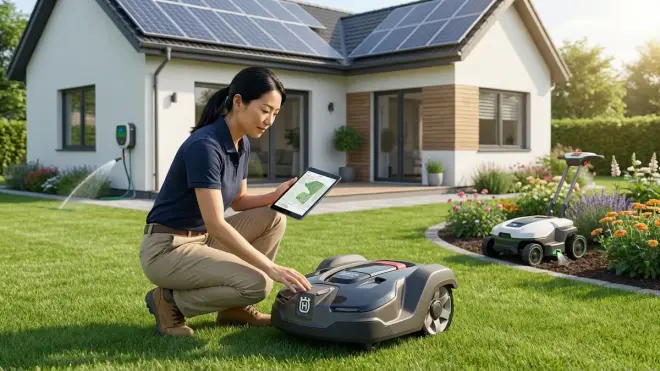
Robotic mowers operate on different logic. Boundary definition happens through buried perimeter wire or GPS-based virtual fences—though the GPS approach introduces 3-6 foot accuracy limitations that can result in occasional edge overruns. The Husqvarna Automower 450XH uses buried wire paired with ultrasonic obstacle detection, navigating lawns in semi-random patterns that gradually cover the entire area. The randomness is deliberate; it prevents visible mowing tracks and distributes wear evenly.
Obstacle avoidance varies by model. Basic units detect physical contact and reverse direction—adequate for static objects like trees or furniture, frustrating when they repeatedly bump the same garden ornament. Advanced models use tilt sensors, lift detection, and ultrasonic ranging to avoid obstacles before contact. Latency matters: a mower traveling at 0.5 meters per second needs sub-100ms sensor-to-motor response to avoid damaging delicate plantings.
Integration into broader smart home ecosystems remains inconsistent. Wi-Fi-based mowers and irrigation controllers can often trigger or be triggered by other devices through platforms like Home Assistant or SmartThings, but the automation possibilities are limited by what manufacturers expose through their APIs. For instance:
IF mower_status == "docked_charging" AND outdoor_camera detects motion_in_lawn_area
  THEN pause_mower_scheduled_start FOR 2_hours
This kind of cross-device logic requires a hub capable of querying multiple device states simultaneously—challenging when devices use different protocols. A mower on Wi-Fi, motion sensor on Zigbee, and irrigation controller on Z-Wave won't communicate directly without a unified controller interpreting each protocol. Understanding Hub Requirements: Which Smart Devices Need a Bridge in 2026 explores these compatibility hurdles in detail.
Fallback behavior determines what happens when connectivity fails. Quality irrigation controllers continue executing the most recently calculated schedule when internet access drops, falling back to basic timer mode if sensor data goes stale. Robotic mowers typically halt operation when they lose GPS lock or can't establish cloud connection—a safety feature that prevents runaway behavior but means your lawn doesn't get mowed during a router outage unless the device has local autonomy. Few manufacturers document these failure modes transparently; testing them requires deliberately disconnecting devices and observing behavior.
Latency in autonomous landscaping differs from indoor smart home expectations. Irrigation valve response times of 2-5 seconds are imperceptible in practice. Robotic mower navigation decisions operate on 50-200ms cycles—fast enough for safe obstacle avoidance. The critical latency appears in decision-making cycles: how quickly does the system incorporate new sensor data into upcoming actions? A controller that recalculates schedules hourly responds adequately to changing weather; one that updates only nightly may waste water on a day when afternoon thunderstorms were unpredicted at dawn.
Why Autonomous Landscaping Technology Matters
The practical significance extends beyond convenience into resource stewardship. Traditional irrigation systems apply water on fixed schedules regardless of need, leading to overwatering during cool periods and stress during heat waves. Autonomous systems adjust continuously, reducing residential outdoor water use by 30-50% in most climates—not through deprivation, but through precision. Plants receive what they need when they need it, soil retains moisture longer due to early-morning application windows, and runoff decreases because controllers split long cycles into multiple short ones that allow absorption.
For those managing larger properties, the labor reallocation matters as much as the resource savings. Weekly mowing represents 3-5 hours on a half-acre lot; delegating that task to autonomous equipment returns time while producing superior results. Robotic mowers cut frequently—often three to five times weekly—removing only millimeters per pass. This continuous trimming eliminates the stress of removing several inches at once, keeps grass healthier, and returns fine clippings as natural fertilizer. The lawn improves because it's never shocked by aggressive cutting.
The sensory experience shifts noticeably. No weekend morning roar of gasoline engines. No glaring evidence of technology—sensors disappear into beds, mowers dock in discreet stations that resemble shed corners, valve controllers mount inside utility boxes you never see. The landscape simply maintains itself, appearing tended by invisible hands. I've worked with clients who initially resist outdoor automation because they associate it with industrial or commercial properties—sterile, utilitarian spaces. The revelation comes when they realize autonomous technology produces the opposite effect: gardens that feel personal and cared-for, because the systems respond to nuance rather than brute-force scheduling.
Energy consumption deserves consideration. Robotic mowers use significantly less energy than gasoline models—typically 20-30 kWh per mowing season for a half-acre property versus 100+ kWh of gasoline energy equivalent. Smart irrigation controllers add negligible load, usually under 10 watts when actively controlling valves. Solar-powered sensors eliminate even that minimal draw. When coordinated with smart home energy management systems, outdoor automation can align with off-peak electricity rates, charging mowers and running high-draw irrigation pumps during cheaper utility windows.
The aesthetic dimension matters in ways that transcend pure function. Autonomous systems enable landscape designs previously impractical to maintain. Complex layered beds with varying moisture requirements become manageable when irrigation zones can deliver customized schedules to each microclimate. Sweeping lawn areas that would demand hours of manual mowing or expensive landscaping services become viable for homeowners who value the visual expanse but not the maintenance burden.
Types and Variations of Autonomous Landscaping Technology
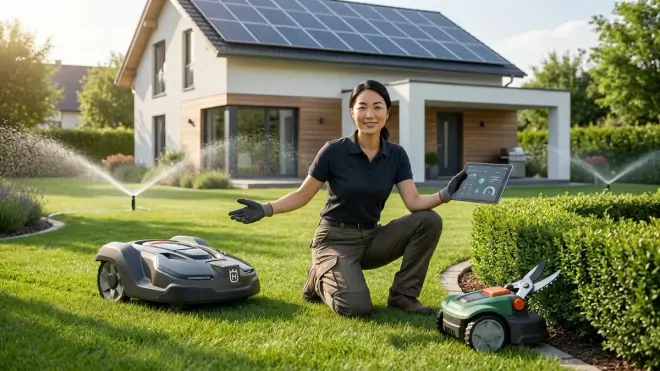
Autonomous landscaping technology clusters into four functional categories, each addressing different aspects of outdoor maintenance.
Robotic mowing systems range from basic boundary-wire models suitable for flat quarter-acre lots to GPS-enabled units capable of mapping complex multi-acre properties with slopes, narrow passages, and multiple zones. Entry-level models handle simple perimeters but struggle with tight corners or frequent obstacles. Premium units incorporate cellular connectivity for remote monitoring, theft tracking, and software updates. Some models now include mulching adjustments based on grass growth rate detected through blade resistance—extending autonomy into quality-of-cut decisions, not just coverage patterns.
Smart irrigation controllers divide into two architectures: hub-based systems that centrally manage multiple zones, and distributed valve controllers that operate independently with cloud coordination. Hub systems (typically Wi-Fi) offer simpler installation for existing wired sprinkler infrastructure. Distributed controllers (often using Zigbee or sub-GHz mesh protocols) excel in sprawling properties where running long wire runs to a central hub becomes impractical. The distributed approach introduces mesh reliability considerations—if one valve controller loses connection, does it fail open, closed, or execute the last-known schedule? Smart Device Fallback Behavior Checklist: What Happens When Wi-Fi or Hubs Fail details these failure modes across common devices.
Autonomous lighting systems for landscapes operate differently than indoor smart lighting. Outdoor fixtures must handle temperature extremes, moisture, and UV exposure while maintaining wireless connectivity. Most use Wi-Fi or Zigbee protocols, with newer installations increasingly adopting Thread for improved range and mesh resilience. Path lighting can adjust based on ambient brightness, motion detection, or scheduled events. Accent lighting might intensify during evening hours when the household typically uses outdoor spaces, then dim to low security levels overnight. The automation logic typically includes:
IF lux_sensor < 50 AND time BETWEEN sunset AND 10:30_PM
  THEN set_landscape_lights TO 80%_brightness
ELSE IF time BETWEEN 10:30_PM AND sunrise
  THEN set_landscape_lights TO 20%_brightness
Environmental monitoring systems form the sensing backbone that enables other devices to operate autonomously. Beyond basic soil moisture, these networks can include rain gauges, anemometers, temperature probes at multiple heights (ground level versus tree canopy), and even pest detection sensors that use acoustic monitoring or image recognition to alert you to unusual insect activity. These sensors rarely trigger actions directly; instead, they feed data into dashboards or intermediate controllers that calculate composite conditions and decide whether to water, adjust lighting, or send alerts.
The invisible alternative to visible sensors and devices deserves emphasis. Robotic mowers can dock in custom-built enclosures that blend into landscaping—tucked behind hedges, integrated into retaining walls, or disguised as decorative garden boxes. How to Hide Smart Home Devices Without Blocking Wireless Signals offers detailed strategies for concealing devices while preserving wireless performance. Irrigation valve controllers can mount inside existing utility boxes or below grade in waterproof vaults accessed only during maintenance. Soil sensors come in earth-tone casings barely larger than plant stakes, or can be buried entirely with only a small antenna node visible at soil level.
Frequently Asked Questions
What is autonomous landscaping technology and how does it differ from traditional smart outdoor devices?
Autonomous landscaping technology uses environmental sensors and conditional logic to make maintenance decisions based on real-time conditions, rather than executing fixed schedules. Traditional smart devices allow remote control or basic scheduling, but autonomous systems adjust behavior dynamically—skipping irrigation when soil moisture is adequate, altering mowing frequency based on growth rate, or modifying lighting schedules according to seasonal sunset times without manual reprogramming.
Which smart home protocols work best for autonomous landscaping systems?
Wi-Fi dominates for robotic mowers and irrigation controllers that require cloud connectivity for weather data and remote access, though it consumes more power than alternatives. Zigbee and Z-Wave excel for valve controllers and sensors in distributed systems due to their mesh networking and low power consumption. Thread is emerging as the preferred protocol for new installations requiring long range, low latency, and Matter 1.4 cross-platform compatibility. Many properties use multiple protocols with a unified hub coordinating between them—consult How to Connect Robotic Yard Equipment to Your Smart Home Hub for integration strategies.
What happens to autonomous landscaping systems when internet or hub connectivity fails?
Quality irrigation controllers continue executing the most recently calculated schedule locally when internet access drops, falling back to basic timer mode if sensor data becomes unavailable for extended periods. Robotic mowers typically halt operation when they lose cloud connection or GPS lock, prioritizing safety over continued operation. Fallback behavior varies significantly by manufacturer—some devices default to "safe off" states while others execute cached schedules indefinitely. Testing these failure modes before relying on devices for extended unattended periods is essential.
Can autonomous landscaping technology integrate with existing indoor smart home systems?
Integration depends on protocols and ecosystem compatibility. Wi-Fi-based outdoor devices often connect to platforms like Home Assistant, SmartThings, or Apple HomeKit through official integrations or community plugins, enabling cross-device automations. Devices using proprietary protocols or limited APIs may report status but not accept external commands. For example, you might trigger irrigation based on indoor energy demand to avoid peak electricity rates, or pause mower operation when outdoor cameras detect activity. Full integration requires verifying both protocol compatibility and exposed automation capabilities—reference Smart Home Ecosystem Compatibility Checklist: Avoiding Device Conflicts before purchasing.
How much maintenance do autonomous landscaping systems require?
Robotic mowers need blade replacement every 1-3 months depending on lawn size and frequency of use, plus periodic cleaning of wheels, sensors, and undercarriage—typically 15-20 minutes monthly. Smart irrigation controllers require seasonal schedule reviews and sensor calibration annually. Soil moisture sensors may need cleaning or repositioning if readings drift. Weather stations need clear sightlines maintained and occasional anemometer cleaning. Overall maintenance averages 2-3 hours per season for typical residential systems, versus 80-100 hours annually for manual mowing and reactive irrigation adjustments—a substantial time reduction while producing better outcomes.
Summary
Autonomous landscaping technology transforms outdoor spaces from maintenance obligations into self-regulating environments that respond to conditions you'd never notice or have time to address manually. The technology consists of networked sensors, actuating devices, and conditional logic that collectively make decisions about watering, mowing, lighting, and monitoring based on real-time environmental data rather than rigid schedules.
The systems rely primarily on Wi-Fi for devices requiring cloud connectivity and weather integration, Zigbee or Z-Wave for distributed sensors and valve controllers, and increasingly Thread for new installations prioritizing range and mesh resilience. Integration into broader smart home ecosystems varies by manufacturer openness and protocol compatibility, with meaningful cross-device automation possible but requiring verification of exposed capabilities.
What makes this technology valuable isn't novelty—it's the quiet accumulation of small optimizations that compound into substantial resource savings, time reclamation, and landscape health improvements that manual attention rarely achieves. The best implementations disappear entirely from view, leaving only the experience of grounds that thrive without demanding your weekends. Your landscape becomes a space you inhabit rather than a list of tasks requiring completion, maintained by technology that serves invisibly from within the environment itself.