


For those aging in place, technology should fade into the architecture of daily life—anticipating needs without demanding attention. Matter protocol for seniors explained becomes essential when designing homes where a light responds to presence without a complicated app, where temperature adjusts without memorizing schedules, and where family members across different tech ecosystems can monitor well-being seamlessly. This unified language between smart devices transforms assistive technology from a visible reminder of vulnerability into an invisible support system that preserves dignity and independence.
What Is Matter Protocol?
Matter is a universal smart home communication standard that allows devices from different manufacturers—Apple, Google, Amazon, Samsung, and hundreds of others—to work together without platform barriers. Released in late 2022 and now in its Matter 1.4 specification as of 2026, it runs over existing infrastructure: Thread (a low-power wireless mesh network), Wi-Fi, and Ethernet. Unlike Zigbee or Z-Wave, which required dedicated hubs and locked users into specific ecosystems, Matter creates a shared vocabulary.

When I specify lighting for a client's home, I'm no longer choosing between Philips Hue's Zigbee ecosystem or waiting to see if a new switch will work with their existing Google Home setup. A Matter-certified bulb speaks to an Apple HomePod, an Amazon Echo, or a Google Nest Hub identically. The protocol handles authentication, security (using the same cryptographic standards as online banking), and command translation behind the scenes.
For seniors, this technical unification has profound practical implications. Adult children with iPhones can help manage a parent's home even if that home runs primarily on Google devices. A visiting nurse can adjust lighting through voice commands regardless of the underlying platform. Understanding Matter protocol for seniors explained means recognizing that the technology adapts to the person, not the reverse—exactly the design philosophy that makes aging in place graceful rather than grudging.
Matter does not replace Thread, Zigbee, or Z-Wave entirely. Instead, it sits atop Thread and Wi-Fi as an application layer, defining how devices describe themselves and respond to commands. Thread provides the low-latency mesh networking underneath, while Matter ensures the devices themselves are interoperable.
How Matter Protocol Works
Matter's architecture rests on three components: devices (sensors, lights, locks), controllers (hubs that send commands), and border routers (bridges between Thread networks and your home's Wi-Fi/Ethernet backbone).
The Communication Flow
When you say "dim the living room lights" to a voice assistant, this happens behind the scenes:
IF voice command received
  THEN controller (Echo, HomePod, Nest Hub) authenticates user
  AND translates command into Matter command language
  AND sends encrypted message to target device(s) via Thread or Wi-Fi
  THEN device(s) acknowledge receipt
  AND execute command (dim to specified percentage)
  AND report new state back to controller
  ELSE timeout after 2-3 seconds, retry once, then report failure
Latency expectations: Matter over Thread typically responds within 200-500 milliseconds for lighting commands—fast enough to feel instant. Matter over Wi-Fi can range from 300ms to 2 seconds depending on network congestion, because Wi-Fi prioritizes bandwidth over responsiveness. For safety-critical applications like fall detection or door locks, Thread's reliability advantage becomes significant.
Thread's Mesh Network Advantage
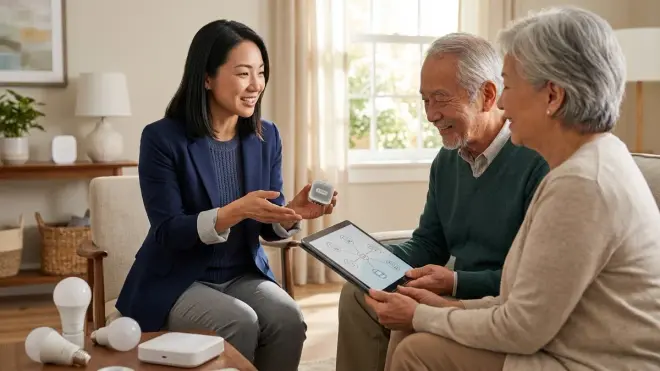
Unlike Wi-Fi, where every device connects directly to your router (creating congestion), Thread builds a self-healing mesh. Each powered device—a smart outlet, a hardwired switch—acts as a relay point. If one node fails, messages route around it automatically. I've installed Matter-over-Thread lighting in homes where thick plaster walls would cripple Wi-Fi signals; the mesh simply adapts, creating pathways through outlets and switches embedded throughout the space.
Minimum mesh requirement: You need at least one Thread border router (many 2026 smart hubs include this) and ideally three to five powered Thread devices to establish a robust mesh. Battery-powered sensors like motion detectors or door contacts can then "sleep" between events, conserving power while remaining reachable through the mesh.
Fallback Behavior and Reliability
Matter devices must declare their fallback state during commissioning—what happens if the network connection drops. For seniors living alone, this becomes critical:
- Smart locks: Should default to their last commanded state (locked or unlocked), not automatically unlock.
- Lighting: Can be configured to either maintain current state or return to 50% brightness if connection is lost during a command.
- Motion-activated nightlights: Should continue local automation (if motion detected, turn on) even without hub connectivity, using onboard logic.
Not all Matter devices implement robust fallback equally. When evaluating products for senior households, I specifically test what happens when I unplug the hub mid-routine. Devices that freeze or become unresponsive require a manual power cycle—unacceptable for someone with limited mobility. Testing smart device response times and latency across protocols reveals these gaps before installation.
Why Matter Protocol Matters for Senior Living
The protocol's significance extends beyond technical elegance into the everyday texture of aging safely at home.
Ecosystem Flexibility Without Retraining
Most seniors I've worked with develop comfort with one interface—"I know how to ask Alexa"—and resist learning new systems. When a family member gifts a new device from a different ecosystem, it often sits unused. Matter dissolves this barrier. That Google Nest doorbell your daughter installed works with your established Alexa routines. The Thread-enabled motion sensor your son added communicates with the existing hub without requiring new apps or account linking.
Family-Wide Monitoring Without Platform Lock-In
Adult children scattered across different ecosystems can now monitor and assist simultaneously. Your iPhone-using daughter checks whether the front door locked each night through her Home app. Your Android-loyal son receives temperature alerts through Google Home. Both access the same devices, the same status information, with no compatibility translation required. This interoperability transforms smart home monitoring from a single-gatekeeper responsibility into a distributed family support system.
Future-Proofing Against Obsolescence
Proprietary protocols create abandonment risk. I've redesigned homes where perfectly functional Z-Wave devices became orphaned when manufacturers discontinued cloud services. Matter's local control requirement—devices must function without cloud dependency for core features—protects against this. Even if a manufacturer exits the market, Matter devices continue operating through any compatible controller. For seniors planning to age in place over decades, this durability matters profoundly.
Matter Protocol Device Types and Limitations
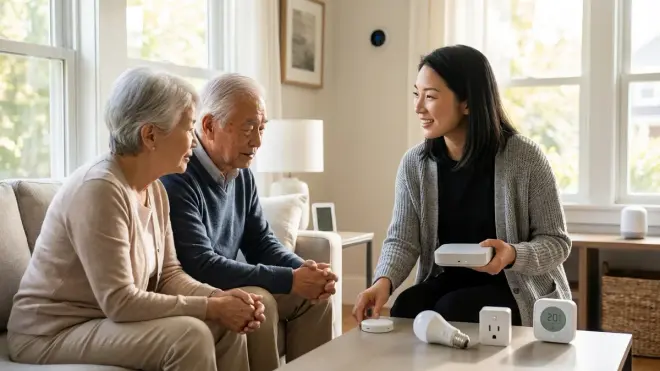
As of Matter 1.4 in 2026, the protocol officially supports these device categories:
Fully Supported Device Classes
- Lighting: Bulbs, strips, switches (on/off, dimming, color temperature, RGB)—typically 200-400ms latency over Thread
- Plugs and outlets: Smart plugs with energy monitoring (reporting accuracy ±2-5% compared to dedicated monitors)
- Switches and controls: Wall switches, remotes, scene controllers
- HVAC: Thermostats (heat/cool modes, fan control, humidity sensing)
- Locks: Smart door locks with remote lock/unlock, status reporting
- Sensors: Door/window contacts, motion sensors, temperature/humidity sensors
- Blinds and shades: Motorized window coverings with position control
- Safety devices: Smoke and CO detectors, water leak sensors
Protocol Limitations and Gaps
Cameras remain outside Matter 1.4's scope—too much bandwidth variance, too many competing video codec standards. Security cameras still require manufacturer-specific ecosystems. For seniors prioritizing subscription-free security systems, this means pairing Matter devices (sensors, locks) with a separate camera solution.
Appliances and specialized medical devices also fall outside current specifications. That smart medication dispenser or fall detection system likely uses Wi-Fi or Zigbee with manufacturer-specific apps. I've integrated covert sensors into senior homes where mixing protocols is inevitable—Matter handles the ambient environment while specialized Zigbee or Wi-Fi devices manage health monitoring.
Energy monitoring granularity varies. While Matter smart plugs report real-time power consumption, they lack the circuit-level detail of dedicated monitors like the Emporia Vue or Sense system. For comprehensive energy management, Matter works alongside rather than replacing these tools.
Thread vs Wi-Fi Matter: Choosing the Right Path
Thread excels when you need:
- Dozens of devices creating mesh redundancy
- Battery-powered sensors maximizing sleep cycles
- Minimum latency for lighting and motion response
- Thick walls or complex floor plans requiring mesh self-healing
Wi-Fi Matter works when you have:
- Fewer than ten devices total
- Strong Wi-Fi coverage throughout the space
- Existing Wi-Fi smart home investment (adding Thread requires new border routers)
- Devices like video doorbells that need high bandwidth anyway
For senior installations, I default to Thread-based Matter unless the home already has robust Wi-Fi coverage and minimal device count. The mesh resilience matters more than raw speed when reliability determines whether someone can safely navigate their space at night.
Frequently Asked Questions
Does Matter protocol work if my internet goes out?
Yes, for local automations and control—Matter's local control requirement means devices respond to controllers on the same network even without internet. If your Thread border router or Wi-Fi hub remains powered, you can still control lights, locks, and sensors through voice or apps. However, remote access from outside your home and cloud-dependent features (weather-based automations, remote notifications to family members) will fail until internet returns. This makes Matter particularly suitable for aging in place scenarios where independence shouldn't rely on ISP uptime.
Can I mix Matter devices with my existing Zigbee or Z-Wave devices?
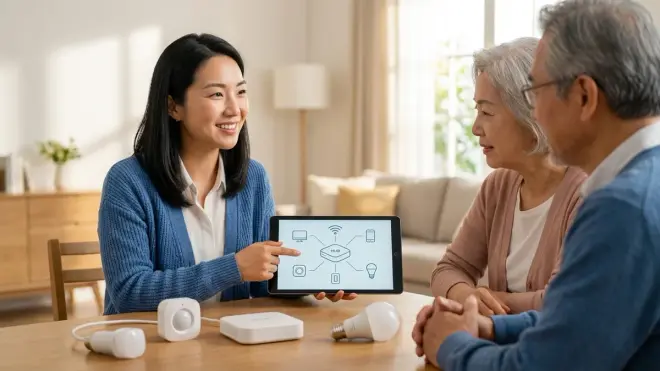
Yes, but through separate control paths—they won't communicate directly with each other. Most 2026 smart hubs like Samsung SmartThings or Hubitat support multiple protocols simultaneously, acting as translators. You create automations at the hub level: IF Zigbee motion sensor detects movement, THEN turn on Matter lights. The hub bridges the protocols, though this adds roughly 200-500ms latency compared to same-protocol communication. For seniors, this mixed approach works well when gradually migrating to Matter without replacing functional existing devices.
How do I know if a device truly supports Matter or just claims compatibility?
Look for the official Matter certification logo—a stylized "M" with three interlocking arcs—on packaging and the Connectivity Standards Alliance certified product database. Marketing materials often blur lines between "works with Matter" (requires a bridge) and "Matter-certified" (native support). Genuine Matter devices include a unique QR code or numeric pairing code you scan during setup. If the device requires downloading a manufacturer's separate app before it works with your Apple/Google/Amazon controller, it's likely bridged rather than native. Understanding Matter 1.4 compatibility requirements helps navigate these distinctions before purchasing.
Will Matter devices stop working if the manufacturer goes out of business?
Core functions—turning lights on/off, reading sensor states, locking/unlocking—will continue indefinitely because Matter requires local control without cloud dependencies. However, firmware updates, advanced features tied to manufacturer servers (vacation modes, AI-based learning), and customer support obviously cease. This represents a dramatic improvement over proprietary cloud-only devices, which become electronic bricks when servers shut down. For senior safety applications, prioritize devices from established manufacturers or those with proven long-term support, but know Matter's architecture provides baseline protection against obsolescence that previous protocols lacked.
Is Matter more secure than older smart home protocols like Zigbee or Z-Wave?
Matter implements modern cryptographic standards comparable to banking security—AES-128 encryption, certificate-based authentication, and mandatory secure boot. Zigbee 3.0 and Z-Wave S2 also use strong encryption when implemented correctly, but many older devices on those protocols predate security requirements. Matter's advantage is security by design rather than by vendor choice—certification requires it. For senior households where a compromised smart lock or camera poses genuine safety risk, Matter's enforced security baseline provides meaningful protection. That said, network security still depends on your router configuration and Wi-Fi password strength; Matter can't protect against a fundamentally insecure home network.
Summary
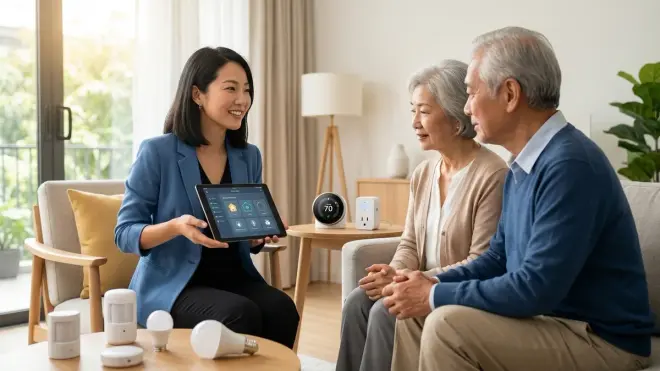
Matter protocol for seniors explained distills to this: technology that adapts rather than demands adaptation. By creating a universal language between devices, Matter transforms smart homes from a collection of competing ecosystems into an invisible infrastructure that responds consistently, reliably, and without requiring mastery of multiple apps or interfaces. The protocol runs over Thread or Wi-Fi, maintains local control when internet fails, and protects against obsolescence—qualities that align precisely with the needs of those aging in place.
When designing spaces for clients who want safety features without surrendering their homes' character to visible technology, Matter's interoperability becomes the foundation. The motion sensors tucked into millwork, the switches that dim evening light as routines wind down, the locks that report status to adult children across different devices—these function as a cohesive whole precisely because Matter eliminated the friction between them.
Choose Thread-based Matter devices for homes requiring mesh resilience across challenging floor plans. Verify true certification through the official database. Test fallback behavior during installation, not during an emergency. And remember that technology serves best when it becomes part of the home's natural rhythm—felt in its effects, invisible in its presence.