
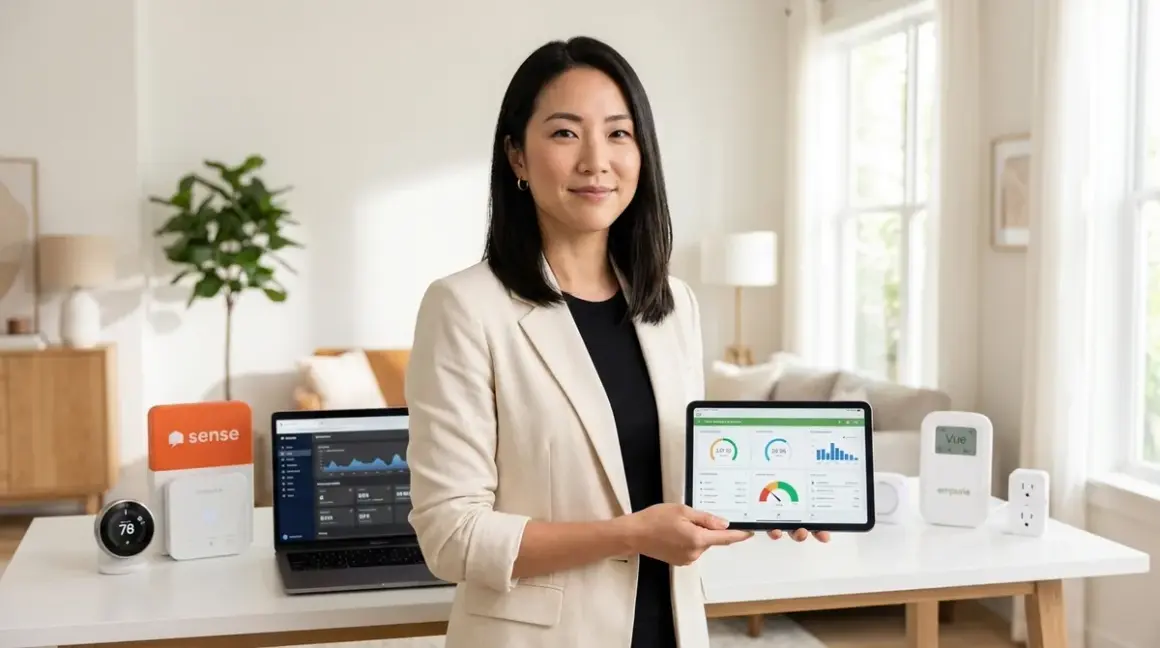

For design-conscious homes, the Emporia Vue disappears more gracefully behind electrical panels, while Sense offers more sophisticated device detection—but both require visible main panel installation that disrupts the clean aesthetic most thoughtfully designed spaces deserve. This comparison explores the sense vs emporia vue energy monitor debate through the lens of spatial integration, examining how each system performs when energy awareness must exist without announcing itself.
Quick Comparison
| Criterion | Sense | Emporia Vue |
|---|---|---|
| Protocol & Integration | Wi-Fi only; HomeKit, Alexa, Google; no Zigbee/Z-Wave/Matter | Wi-Fi only; Alexa, Google; no HomeKit, Zigbee, Z-Wave, or Matter |
| Installation Footprint | Single unit at main panel; ~5" × 7" visible enclosure | Modular sensors; compact 3.5" × 5" hub; expandable to subpanels |
| Device Detection | AI-driven automatic detection; 20+ devices typical | Manual circuit mapping; unlimited individual circuit tracking |
| Real-Time Latency | ~0.5-1 second refresh; cloud-dependent | ~1 second refresh; cloud-dependent for app access |
| Automation Logic | Native IFTTT, HomeKit, webhooks; limited conditional triggers | IFTTT, webhooks; requires third-party hub for complex automation |
Protocol Compatibility and Ecosystem Lock-In
Neither the Sense Energy Monitor🛒 Amazon nor the Emporia Vue Smart Home Energy Monitor🛒 Amazon speaks the languages that allow truly invisible automation. Both devices communicate exclusively via Wi-Fi 2.4 GHz, which means they bypass the low-power mesh networks—Zigbee, Z-Wave, Thread—that typically enable concealed sensors to coordinate without visual hubs cluttering countertops.

Sense integrates with Apple HomeKit (via Wi-Fi), allowing basic conditional logic within the Home app:
IF sense.total_power > 5000W
THEN notify "High consumption detected"
It also supports Amazon Alexa and Google Assistant for voice queries, plus native IFTTT webhooks for cross-platform triggers. However, it lacks Matter 1.4 support, meaning it won't participate in the cross-controller automations that newer smart home ecosystems promise. Latency from detection to notification typically hovers around 0.5-1 second under normal network conditions, but cloud dependency introduces failure points: if your internet drops, real-time monitoring stops.
Emporia Vue omits HomeKit entirely, supporting only Alexa and Google Assistant for voice integration. Its automation capabilities require external platforms—IFTTT or a home automation hub like Home Assistant—to execute conditional logic:
IF emporia.circuit_12.power > 1500W
AND time.is_peak_rate == TRUE
THEN notify "Dryer running during peak hours"
Like Sense, it lacks Zigbee, Z-Wave, Thread, and Matter compatibility, so it cannot trigger mesh-network devices directly. Refresh rates sit at approximately 1 second, also cloud-dependent. For deeper automation, users typically integrate via Home Assistant's REST API or similar platforms, introducing additional complexity but enabling sophisticated energy-saving automations that neither device offers natively.
The absence of local-first protocols means both monitors remain dependent on manufacturer cloud services. If either company discontinues support, the hardware becomes ornamental. This vulnerability matters in homes where technology investments must outlast trend cycles.
Invisible Alternative: For spaces where no visible energy monitor is acceptable, consider integrating smart plugs with built-in energy metering at individual high-draw appliances instead. Devices like Zigbee-enabled Aqara Smart Plug T2 or Z-Wave Zooz ZEN15 tuck behind furniture and feed data to a concealed smart home hub, eliminating the need for main panel modifications entirely. This approach sacrifices whole-home visibility but preserves aesthetic integrity.
Installation Footprint and Physical Presence
Energy monitors require electrical panel access, which inherently conflicts with the 'felt, not seen' principle. Yet the degree of intrusion varies significantly between the sense vs emporia vue energy monitor debate.
Sense installs as a single consolidated unit mounted directly inside or adjacent to the main electrical panel. The device measures roughly 5" × 7", with two current transformer (CT) clamps that wrap around the main service lines entering your panel. Installation requires shutting off main power and working within the panel enclosure—tasks that demand a licensed electrician in most jurisdictions. The monitor itself protrudes from the panel, visible whenever someone opens the utility closet or basement space where panels typically hide. In homes where the electrical panel occupies a hallway or mudroom—a reality in many condos and townhomes—this becomes a permanent visual reminder of the technology layer beneath daily life.
I've worked with clients who relocated entire electrical panels during renovations specifically to hide monitoring equipment behind finished walls with service-only access panels. This isn't always feasible, especially in multifamily buildings where panel locations are fixed by code.
Emporia Vue offers a modular approach: a compact main hub (3.5" × 5") mounts near the panel, with individual CT clamps for up to 16 circuits (8-circuit and 16-circuit versions available). The advantage here lies in scalability and discretion—the hub can mount inside the panel enclosure or adjacent to it, and the thin CT sensor wires route neatly. For homes with subpanels—common in finished basements, detached garages, or additions—Emporia sells expansion modules, allowing energy tracking across distributed electrical infrastructure without running new monitoring hardware to each location.
Both systems require 240V breaker space for power, and both necessitate licensed electrician installation to meet code and maintain warranty coverage. Neither can be installed by a homeowner without electrical expertise, which adds roughly $150-$300 in labor costs on top of hardware.
The physical intrusion is unavoidable, but Emporia's smaller footprint and modular design make it marginally easier to conceal within panel enclosures, especially in newer homes with spacious panels. Sense's all-in-one approach simplifies wiring but demands more visible real estate.
Invisible Alternative: If your goal is circuit-level insight without panel modifications, deploy individual smart breakers like Leviton's Smart Load Center or Span's Smart Panel. These replace the entire electrical panel with a smart-enabled version, integrating energy monitoring directly into the breaker infrastructure. The panel looks conventional from the outside—no auxiliary boxes—but delivers granular, per-circuit data. This solution carries significant upfront cost but eliminates the "add-on" aesthetic that both Sense and Emporia introduce. Learn more about hidden smart home installation requirements before pursuing panel-level overhauls.
Device Detection Philosophy and Data Granularity
The core functional divide in the sense vs emporia vue energy monitor comparison lies in how each system makes sense of electrical consumption—and whether you prefer algorithmic intelligence or manual precision.
Sense employs machine learning-based device detection, analyzing the unique electrical signatures of appliances as they cycle on and off. Over days and weeks, the system learns to distinguish your refrigerator's compressor kick-in from your washing machine's spin cycle, your electric vehicle charger from your HVAC blower motor. This happens automatically, without circuit mapping or manual tagging.
In practice, detection accuracy varies. Large, consistent-draw devices—HVAC systems, water heaters, EV chargers, ranges—register quickly, often within the first week. Smaller or variable-load devices—LED bulbs, phone chargers, laptops, variable-speed fans—rarely achieve reliable detection. Sense's algorithm struggles with devices that share similar power profiles (multiple space heaters, for instance) and occasionally misidentifies devices entirely, labeling a toaster as a hair dryer or bundling multiple small loads into a generic "other" category.
Users report detecting an average of 20-25 devices after six months, though homes with simpler electrical profiles (fewer smart devices, older appliances with distinct signatures) see better results. The system improves over time but never reaches 100% granularity. For residents who value passive observation—understanding energy flows without intervention—this approach feels appropriate. It mirrors the way natural light shifts through a room without demanding acknowledgment.
Emporia Vue, by contrast, requires manual circuit mapping. You physically label each circuit in your electrical panel, assigning a clamp to specific breakers. The system immediately shows exactly what each circuit consumes, down to the watt. Want to know if your basement dehumidifier is cycling properly? Check circuit 14. Curious whether the garage door opener is drawing phantom load overnight? Look at circuit 9.
This granularity appeals to those who appreciate precision—who want to track specific appliances rather than rely on algorithmic guesses. Emporia supports up to 16 individual circuits (with expansion modules enabling more), making it ideal for homes with dedicated circuits for major loads: kitchen appliances, laundry, pool pumps, workshop equipment.
The tradeoff: you must spend time at your electrical panel with a notepad, flipping breakers and documenting which circuit controls what. For spaces where the panel is buried behind a finished wall or located in a cramped utility closet, this becomes tedious. But once mapped, the data is unambiguous. No misidentifications, no waiting for detection, no algorithmic drift.
For automation-focused homes, Emporia's circuit-level precision enables targeted triggers:
IF emporia.circuit_kitchen.power > 3000W
AND time.hour >= 22
THEN send_notification "High kitchen load detected after 10 PM"
Sense can trigger on total home consumption or detected devices, but its device list remains dynamic and sometimes unreliable:
IF sense.device_detected == "Water Heater"
AND sense.device_state == "On"
THEN log_event "Water heater cycle started"
Neither monitor offers sub-second latency—both refresh approximately every second—but Emporia's deterministic circuit mapping provides more consistent automation reliability. Sense's AI detection introduces variability that can cause automations to fail when devices go unrecognized.
For deeper insight into how to structure energy-saving conditional automations, especially around time-of-use rates, explore platforms that integrate both monitors with third-party controllers.
Real-Time Monitoring, Data Retention, and Cloud Dependency
Both devices promise real-time visibility into energy consumption, but "real-time" exists only as long as your internet connection and the manufacturer's cloud infrastructure remain intact.
Sense streams data to its cloud platform with approximately 0.5-1 second refresh intervals, displaying current wattage, daily/weekly/monthly trends, and cost projections (based on manually entered utility rates). The mobile app provides push notifications when specific devices turn on or when consumption exceeds user-defined thresholds. Historical data is retained indefinitely in your account, accessible via the app or web dashboard.
However, local access does not exist. If Sense's servers go offline, or if your home internet fails, the device continues monitoring internally but provides no real-time visibility. There's no local API, no offline dashboard, no fallback to LAN-only operation. This creates a fragile dependency: your energy awareness relies on a startup's continued operation. While Sense has maintained stable service since its 2013 launch, the risk persists.
Emporia Vue operates identically in terms of cloud dependency. Data refreshes every ~1 second, flowing through Emporia's servers to mobile apps and web dashboards. Historical data is retained indefinitely, and users can export to CSV for external analysis. Like Sense, Emporia offers no local-first operation—no LAN API, no offline mode, no fallback interface.
For automation enthusiasts, both devices expose limited local integrations. Sense offers a HomeKit bridge that surfaces total consumption and detected devices as HomeKit accessories, enabling some local automation via Apple devices even if Sense's cloud falters. Emporia lacks this feature but can be integrated with Home Assistant via REST API, pulling data at intervals and triggering local automations—though this still depends on the cloud endpoint being reachable.
Neither device publishes MQTT or local polling APIs, which limits integration with local-storage security and automation systems that prioritize offline resilience.
Fallback behavior for both devices is minimal: they continue logging internally but provide no user interface until connectivity returns. Neither offers cellular backup or SD card logging for truly offline operation.
For homes prioritizing smart home energy management with resilience, this cloud dependency is a design flaw. If either company pivots, sells, or shuts down, the hardware becomes inert. Consider pairing these monitors with a Home Assistant instance running locally, which can cache data and maintain automations even when cloud endpoints fail.
Subscription Costs, Data Ownership, and Long-Term Value
Unlike subscription-dependent security cameras, both Sense and Emporia Vue operate without monthly fees. All features—device detection, historical data, notifications, third-party integrations—are included with the one-time hardware purchase.
Sense retails around $300 for the single-monitor version and $350 for the solar-compatible model (which tracks both grid consumption and solar production). There are no premium tiers, no paywalls for advanced features, no forced upgrades. Data remains accessible indefinitely, and exports are unrestricted.
Emporia Vue costs approximately $100 for the 8-circuit model and $150 for the 16-circuit version, making it significantly more affordable upfront—especially for users who need only a handful of circuits monitored. Expansion modules add roughly $50-$75 each. Like Sense, Emporia charges no subscription fees, and data exports are unlimited.
The absence of recurring costs is rare in smart home infrastructure and should be celebrated. However, data ownership remains ambiguous for both companies. User data resides on proprietary cloud servers, and neither company guarantees perpetual API access or local export tools. If the business model shifts, users could lose historical data or find features paywalled retroactively.
For transparency on subscription-free smart home strategies, including energy monitoring, explore our complete guide to subscription-free security systems, which addresses long-term viability and vendor lock-in risks across device categories.
Who Should Choose Sense
Choose Sense if you value passive intelligence over manual configuration—if you'd rather the system learn your home's rhythms than document every circuit yourself. Its AI-driven device detection suits residents who want a general sense of consumption patterns without precise circuit-level granularity. If you live in a smaller home (under 2,000 square feet) with straightforward electrical infrastructure, Sense's single-unit installation is cleaner and faster.
Sense also makes sense—forgive the pun—for HomeKit-integrated homes where energy data can flow into Apple's ecosystem without additional bridges. Voice queries via Siri, Alexa, or Google Assistant feel natural, and the mobile app's polish makes casual monitoring frictionless.
However, be prepared for imperfect device detection and accept that smaller appliances may never register individually. This monitor rewards patience and tolerates ambiguity—qualities that align with the way a well-designed space reveals itself gradually rather than all at once.
Who Should Choose Emporia Vue
Emporia Vue serves those who demand precision and appreciate the clarity of labeled circuits. If your home has dedicated circuits for major loads—workshop equipment, EV chargers, pool systems, separate HVAC zones—Emporia's modular design allows you to track each independently. This granularity is invaluable for energy audits, identifying high-consumption devices, and optimizing time-of-use rate schedules.
It's also the better choice for multi-panel homes or properties with subpanels, where Sense's single-unit design falls short. Emporia's expansion modules let you monitor distributed electrical infrastructure without installing multiple full systems.
Choose Emporia if you're comfortable with upfront configuration effort and prefer deterministic data over algorithmic interpretation. It's the tool for those who, like a thoughtful designer, measure twice and cut once—who'd rather invest time in accurate setup than troubleshoot misidentified devices later.
The lower upfront cost also matters for budget-conscious households or those testing energy monitoring before committing to a full smart home energy management system.
Frequently Asked Questions
Can Sense or Emporia Vue work without Wi-Fi once installed?
No. Both devices depend entirely on Wi-Fi connectivity and cloud servers for real-time monitoring and historical data access. If your home internet fails or the manufacturer's cloud goes offline, the monitors continue logging internally but provide no user interface—no app access, no automation triggers, no notifications. Neither offers local-only operation via Ethernet or a LAN-based dashboard. For more resilient energy monitoring, integrate either device with a local home automation hub like Home Assistant, which can cache data and maintain automations even during cloud outages, though initial data retrieval still requires internet access.
Do these monitors support solar panel systems or EV chargers?
Sense offers a dedicated solar-compatible model (around $350) that includes additional CT clamps to monitor both grid consumption and solar production simultaneously, calculating net usage and export in real time. It also detects Level 2 EV chargers reliably due to their high, consistent power draw. Emporia Vue supports solar monitoring with its Vue with Solar variant (around $170), which similarly tracks grid and solar circuits separately. Both devices handle EV chargers well—Emporia by assigning a dedicated circuit, Sense through device detection—but neither integrates directly with smart EV chargers to schedule charging based on rates or solar availability without third-party automation platforms.
Can I use Sense or Emporia Vue for time-of-use rate optimization?
Both monitors display consumption data but do not automatically shift loads based on time-of-use (TOU) rates without external automation. You must manually configure conditional triggers using platforms like IFTTT, Home Assistant, or Node-RED. For example, with Emporia Vue integrated into Home Assistant, you could create:
IF time.is_peak_rate == TRUE
AND emporia.circuit_dryer.power > 1000W
THEN send_notification "Dryer running during peak hours—consider pausing"
Sense supports similar logic via HomeKit automations or webhooks, but neither device offers native TOU rate optimization or load scheduling. For hands-off energy cost reduction, pair either monitor with smart plugs on high-draw appliances, using the monitor's data to inform automation rules rather than relying on the monitor itself to execute them.
Bottom Line
The sense vs emporia vue energy monitor decision hinges on whether you value algorithmic elegance or manual precision—whether you'd rather observe consumption patterns emerge naturally or map every circuit with surgical clarity. Sense appeals to those who want passive intelligence woven into their home's rhythm, accepting imperfect device detection in exchange for simplicity. Emporia Vue rewards those who invest time in configuration, delivering circuit-level granularity that enables targeted energy audits and precise automation.
Neither device achieves invisibility—both require visible panel installations that announce their presence. Neither speaks the low-power mesh protocols that enable truly concealed automation. And both depend on cloud infrastructure that could evaporate without warning.
But for homes where energy awareness must exist alongside aesthetic intention, Emporia's modular discretion and lower price point edge out Sense's more intrusive single-unit design. The tradeoff? You'll trade convenience for control, spending hours mapping circuits instead of waiting for AI to guess. That deliberate effort mirrors the way thoughtful design itself unfolds—slowly, with intention, refusing to automate what deserves attention.