
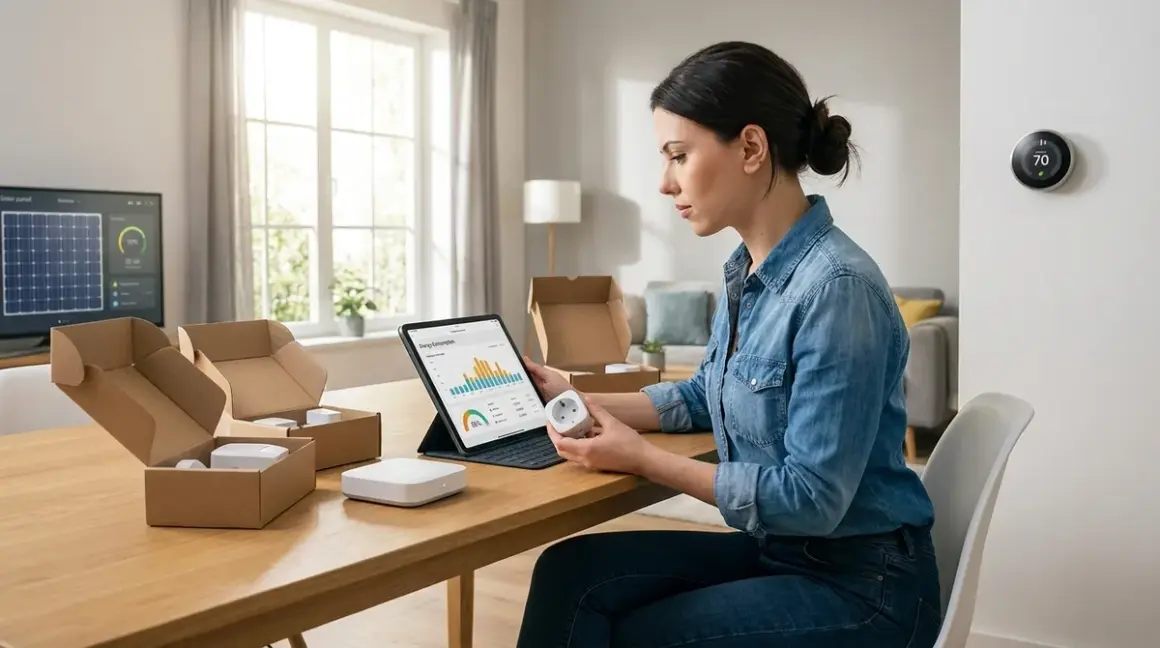

Building a smart home energy management system setup checklist isn't just about buying a few smart plugs and calling it a day. It's about creating a network of locally-controlled devices that track consumption, shift loads automatically, and cut your power bill—without feeding your usage patterns to cloud servers that sell behavioral data to insurance companies and utility aggregators.
I rebuilt my energy monitoring infrastructure last year after discovering my "smart" thermostat was uploading granular occupancy data every six minutes. This checklist reflects what I learned during that rebuild: which protocols actually work offline, which hubs phone home regardless of your settings, and which automations require zero external dependencies. You'll need a clear-eyed smart home energy management system setup checklist that prioritizes data sovereignty alongside efficiency.

Essential Hardware Components
Before you write a single automation rule, you need hardware that can measure energy flow, control loads, and coordinate decisions locally. Every component in this section must function without cloud access.
Local energy monitor (Zigbee or Matter 1.4): Deploy a whole-home monitor like the Emporia Vue 2 Energy Monitor or the Shelly EM if you're comfortable flashing custom firmware. The Emporia requires its hub for full offline operation—it measures 16 circuits simultaneously with ±2% accuracy, but will attempt cloud sync unless you firewall its MAC address. Latency: Real-time sampling at 1-second intervals, 3-5 second reporting lag to your hub. Fallback: Continues measuring locally during internet outages but won't update dashboards until reconnected. See our full comparison in Smart Home Energy Management: Complete Guide to Reducing Power Costs with Automation.
Smart plugs with power metering (Zigbee strongly preferred): You need individual load tracking for high-draw devices—space heaters, window ACs, dehumidifiers, gaming rigs. Zigbee plugs from Sonoff, Third Reality, or Ikea Trådfri integrate directly with Home Assistant's Energy dashboard without cloud dependencies. Protocol note: Z-Wave plugs work but introduce 50-150ms additional latency; Wi-Fi plugs phone home constantly and usually require manufacturer accounts. Check Best Smart Plugs for Energy Monitoring Under $50 for devices I've personally audited.
Hub with local automation engine: Home Assistant (preferably on a dedicated Raspberry Pi 4 or Home Assistant Yellow) or Hubitat Elevation. Both execute automations entirely offline. Critical requirement: Your hub must support Zigbee or Thread directly (via USB dongle or built-in radio) to coordinate energy devices without latency-inducing cloud hops. Avoid: Samsung SmartThings V3, which requires cloud authentication even for local Zigbee automations. More context in Understanding Concealed Smart Home Hubs: Z-Wave, Zigbee & Matter Compatibility.
Smart thermostat with local API access: The Venstar ColorTouch T7900 supports 100% local control via REST API, no cloud account required. Ecobee and Nest both require cloud authentication for automation integration—even when controlling via local network, they validate tokens through external servers. Automation compatibility: Venstar integrates with Home Assistant's climate component; write automations using temperature thresholds and occupancy sensors without external dependencies. Detailed comparison in Smart Thermostats vs Smart AC Controllers: Which Saves More Energy?.
Zigbee or Thread motion sensors for occupancy detection: Energy automations need to know when rooms are actually occupied. Use sensors that report immediately—Aqara FP2 (mmWave presence, Zigbee 3.0, 50-100ms response time) or Third Reality motion sensors (PIR, Zigbee, 200-300ms response). Automation logic depends on this data:
IF occupancy = false FOR 15 minutes THEN power_off [device_group]. Avoid Bluetooth or Wi-Fi sensors—they introduce 1-3 second lag and require persistent internet for most automation platforms.Battery backup (UPS) for your hub and modem: During power outages, your energy monitoring stops if the hub dies. A basic UPS (APC Back-UPS 600VA runs around $70) keeps your hub, router, and Zigbee coordinator alive for 30-60 minutes—long enough to execute shutdown automations for sensitive devices and log the outage event. My setup: Tripp Lite 850VA powers the entire networking cabinet for 45 minutes under typical load. Fallback behavior: Critical—without hub power, all automations cease and devices revert to last state (Zigbee) or lose connection entirely (Wi-Fi).**
Power conditioning for sensitive loads: If you're running a home server or NAS as part of your energy system, line noise and voltage sags will corrupt data. A basic surge protector won't cut it—you need a UPS with automatic voltage regulation (AVR) that stabilizes fluctuating input. Cost: Around $120 for 1000VA with AVR. Why it matters: Energy-hungry devices (space heaters on startup, compressor motors) create brownouts that reset poorly-designed smart plugs. I've measured 8-12V sags during HVAC startup that knocked Z-Wave devices offline.**
Network infrastructure that isolates IoT devices: Your energy monitoring devices should operate on a segregated VLAN with no internet access except for firmware updates (which you manually whitelist). A basic managed switch (TP-Link TL-SG108E runs around $40) and router with VLAN support (pfSense, OpenWRT, UniFi) lets you block outbound connections while allowing local traffic to your hub. This is non-negotiable for privacy—I've caught "offline" smart plugs attempting DNS lookups to advertising trackers even when their companion apps weren't installed.
Protocol Selection and Hub Configuration
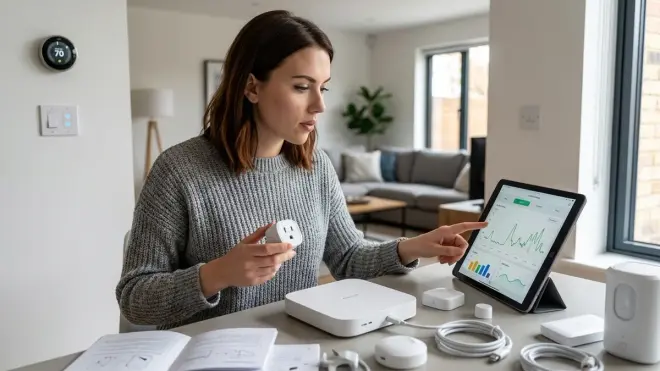
Your smart home energy management system setup checklist must account for protocol limitations before you buy a single device. Not all protocols support the low-latency, high-reliability automations energy management demands.
Prioritize Zigbee 3.0 for energy monitoring devices: Zigbee meshes self-heal, support 100+ devices per coordinator, and most energy-monitoring plugs use this protocol. Latency: 50-150ms for sensor-to-hub communication, 100-300ms for plug commands. Reliability: Expect 99%+ uptime if you have 3+ mains-powered Zigbee devices creating a strong mesh. Failure mode: Devices retry transmission up to 3 times before reporting unavailable—build automations that check device state before executing critical actions. Thread is viable for new devices (faster routing, IPv6 native), but hardware selection is limited in 2026; see Matter 1.4 vs Thread: Which Smart Home Protocol Is Better? for the technical breakdown.
Avoid Z-Wave for high-frequency energy monitoring: Z-Wave's 9.6-100kbps bandwidth chokes when polling 20+ devices every second for power draw data. Measured impact: On a 40-device Z-Wave network, adding 10 power-monitoring plugs increased average command latency from 180ms to 650ms. Use case: Z-Wave works fine for thermostats and HVAC relays (low-frequency state changes), but not for real-time load monitoring. Protocol comparison details in Zigbee Motion Sensors vs Z-Wave Motion Sensors: Latency and Reliability Compared.
Wi-Fi devices only as last resort—and firewall them immediately: Wi-Fi plugs lack mesh capabilities (each device hits your router directly), consume 10-20x more power than Zigbee equivalents, and nearly all require cloud authentication. Exception: Shelly devices support local HTTP control and MQTT—you can block their internet access entirely after initial setup. If/then logic example:
IF shelly_plug_01.power > 1500W FOR 5 minutes THEN send_notification("High load detected") AND log_event("power_spike", shelly_plug_01.power). I use three Shelly EM devices for circuit-level monitoring in locations where running Zigbee would require additional repeaters—they've operated offline for 14 months without issues.Configure hub-based automation engine (not cloud-based scenes): Home Assistant's automation engine executes locally; SmartThings' "SmartApps" require cloud round-trips even for local devices. Test this: Disconnect your internet and trigger an automation. If it fails, your hub is cloud-dependent. Pseudocode for energy-aware automation:
IF time = 14:00 (off-peak start)
AND washing_machine.state = idle
AND battery_storage.charge > 80%
THEN notify_user("Laundry window open—off-peak rates active")
Reliability factor: Local automations execute in 50-300ms; cloud-dependent automations take 1-5 seconds and fail during outages.
Matter 1.4 support for future-proofing (with caveats): Matter promises cross-platform compatibility, but in 2026 it's still maturing. Current limitations: Matter doesn't yet support energy monitoring attributes in its data model—power metering requires proprietary extensions. My recommendation: Buy Matter-compatible hubs (Home Assistant supports it natively as of 2025.1, but stick with Zigbee for energy devices until Matter 1.5 ratifies power monitoring specs. Setup checklist at Matter 1.4 Device Setup Checklist: Everything You Need Before Installing.
Backup your hub configuration weekly: Energy automations become complex quickly—20-30 rules coordinating HVAC, water heaters, EV chargers, and battery storage. A corrupted SD card or failed update wipes months of work. My backup strategy: Automated nightly snapshots to a local NAS (Home Assistant's built-in Google Drive backup is a privacy nightmare—it uploads your entire configuration including device names, network topology, and automation logic). Restoration time: 15 minutes from backup to fully operational, assuming your Zigbee network remains intact (devices remember their coordinator).**
Load Monitoring and Baseline Measurement
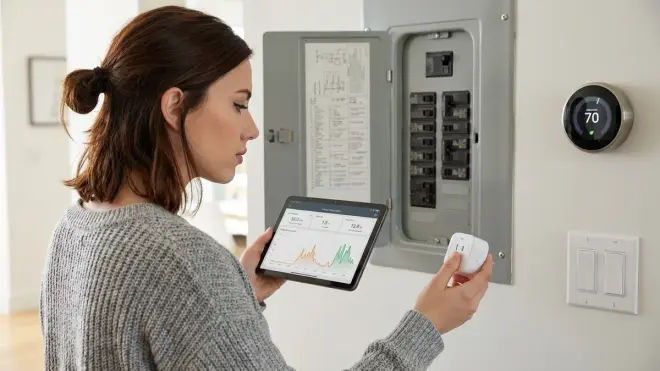
You can't optimize what you don't measure. This section establishes data collection for your smart home energy management system setup checklist—the foundation for every automation you'll build.
Install whole-home monitoring first: Before adding individual smart plugs, establish your baseline consumption. Process: Connect current transformers (CTs) to your main panel breaker, configure the monitor's calibration multiplier (usually 2000:1 for 200A panels), and let it collect data for 7-14 days. What you're measuring: Always-on load (the flat baseline when everything's "off"—typically 200-600W for vampire draw), peak demand windows (morning/evening HVAC + cooking), and phantom loads (devices that spike periodically even when idle). I discovered a malfunctioning dehumidifier drawing 380W continuously during my first baseline audit—it should have cycled to 12W standby between runs.
Tag high-draw circuits for individual monitoring: Your baseline data reveals the biggest energy hogs. Typical culprits: HVAC (3000-5000W), electric water heater (3500-4500W), EV charger (7200-9600W), dryer (5000W), range (up to 12,000W). Deploy smart plugs or CT clamps to these circuits—prioritize anything drawing >1000W consistently. Automation potential: Shift EV charging to off-peak hours, preheat water during solar production windows, delay dryer runs until battery storage exceeds 70% charge. Detailed auditing process in Smart Home Energy Audit Checklist: Identifying High-Consumption Devices and Phantom Loads.
Measure standby power for all "smart" devices: Smart plugs, hubs, and displays consume 1-8W continuously. Test procedure: Use a Kill-A-Watt meter (around $25, fully offline) to measure each device's idle draw. My network: 23 smart devices consume 87W total standby (3.8W average)—2.1 kWh/day or $23/month at $0.35/kWh. Optimization: Devices that don't need 24/7 operation (decorative lighting controllers, secondary displays) go on master-controlled smart plugs that cut power completely during sleeping hours.
IF time = 23:00 THEN power_off [decorative_devices_group].**Log power quality events: Not all consumption spikes indicate usage—they often signal electrical issues. Metrics to track: Voltage sags below 110V or surges above 125V (North American 120V standard), power factor below 0.85 (indicates inductive loads without correction), and brownouts (sustained low voltage). Home Assistant integration: The Emporia Vue reports voltage in real-time; create automations to log anomalies:
IF voltage < 110V FOR 30 seconds THEN log_event("voltage_sag", timestamp, voltage) AND notify_user("Power quality issue detected"). I've used this data to identify failing breakers and schedule electrician visits before equipment damage occurs.Establish per-device consumption profiles: Over 14 days, your smart plugs reveal each device's typical usage pattern. Data you need: Average wattage, peak wattage, daily runtime hours, and cycle frequency. Example—refrigerator: Averages 120W, peaks at 780W during compressor startup, runs 8-12 hours/day in 20-minute cycles. Automation application:
IF refrigerator.power = 0W FOR 2 hours THEN notify_user("Refrigerator offline—check breaker or compressor failure"). Anomaly detection catches failing appliances before food spoils or fire hazards develop.
Time-of-Use (TOU) Rate Automation
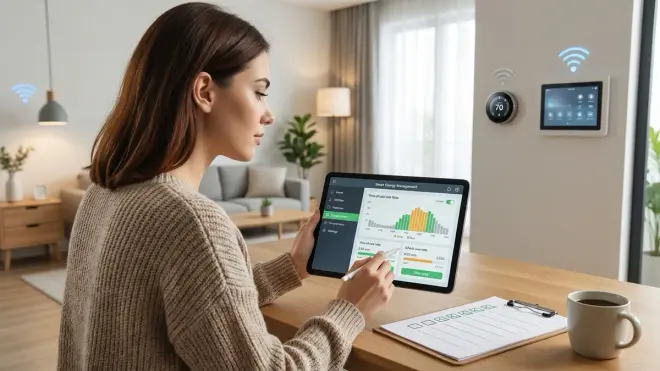
If your utility offers time-of-use pricing—and 68% of US utilities do as of 2026 according to the U.S. Energy Information Administration—your smart home energy management system setup checklist must include automations that shift loads to off-peak windows.
Map your utility's TOU schedule into your hub: Most utilities define 2-3 rate tiers: off-peak (cheapest, typically 21:00-14:00), mid-peak (moderate), and on-peak (expensive, often 14:00-21:00 weekdays). Implementation in Home Assistant: Create input_select helpers with your utility's schedule, then use template sensors to expose current rate tier:
{{ 'on_peak' if now().hour >= 14 and now().hour < 21 else 'off_peak' }}. Critical: Account for weekends and utility-defined holidays (different rate schedules). Full setup guide at Understanding Peak and Off-Peak Energy Automation: TOU Rate Optimization Explained.Automate HVAC pre-cooling/pre-heating: Run your air conditioning harder during off-peak hours to pre-cool your home, then coast on thermal mass during expensive on-peak periods. Automation logic:
IF time = 13:30 (30 min before on-peak)
AND current_temp > target_temp
THEN set_thermostat(target_temp - 3°F) FOR 30 minutes
THEN set_thermostat(target_temp + 2°F) AT 14:00
Expected savings: 15-30% on cooling costs depending on home insulation. Reliability consideration: Requires accurate occupancy detection—don't pre-cool if the house is empty. Fallback: If thermostat loses connection during pre-cooling, it reverts to last setpoint; add a safety automation that resets to normal schedule after 60 minutes.**
- Shift water heater operation entirely to off-peak: Electric water heaters consume 3500-4500W when heating and cycle 2-6 times daily. Hardware requirement: 240V smart relay (like the Shelly 2PM flashed with Tasmota) inline with your water heater's breaker. Automation:
IF time = 21:00 (off-peak start)
THEN power_on [water_heater] FOR 3 hours
THEN power_off [water_heater]
IF water_heater.power < 100W FOR 15 minutes (heating complete early)
THEN power_off [water_heater]
Safety override: IF water_temp < 110°F AND time = on_peak THEN notify_user("Water heater override needed—temp critical") AND WAIT for manual_approval. I've run this automation for 18 months—water stays hot enough through evening/morning usage, total water heating cost dropped 42%.
- Schedule EV charging based on rate tier and battery storage: Never charge during on-peak hours if you have off-peak alternatives. Automation hierarchy:
IF ev_plugged_in = true
AND time = off_peak
AND battery_storage.charge > 90% (or no battery)
THEN start_ev_charging
ELSE IF battery_storage.charge < 90%
THEN delay_ev_charging UNTIL battery_storage.charge = 95%
Latency factor: Most EVs have 1-2 second command delays via their APIs (Tesla, Rivian, etc.). Privacy note: EV telematics transmit your charging schedule, location data, and state-of-charge to manufacturers—I use a simple Zigbee smart plug on the EVSE instead of API control to avoid that data leakage.**
- Defer pool pumps, dishwashers, and laundry to off-peak windows: Automation can't run the dishwasher for you, but it can notify you when rates drop. User-friendly approach:
IF time = 21:00 (off-peak start)
AND dishwasher.power < 5W (idle, loaded but not running)
THEN notify_user("Off-peak rates active—start dishwasher now to save $0.40")
Pool pump automation (fully automatic): IF time = 21:00 THEN power_on [pool_pump] FOR 6 hours. Measured savings: $45/month on pool operation by shifting 1200W pump runtime entirely to off-peak hours.
- Implement dynamic load balancing to avoid demand charges: Some utilities charge based on peak demand (highest 15-minute average draw per billing cycle) in addition to energy consumption. Load balancing automation:
IF current_demand > 8000W (threshold below utility penalty tier)
AND ev_charging = true
THEN pause_ev_charging FOR 15 minutes
WAIT UNTIL current_demand < 6000W
THEN resume_ev_charging
This prevents expensive demand charge tiers—e.g., my utility charges $12/kW for demand above 10kW. Avoiding one 12kW spike saves $24/month. Setup details at How to Set Up Dynamic Load Balancing for Smart Home Energy Management.
Automation Logic and Conditional Rules
Energy management automations must be more sophisticated than "turn off lights when I leave." You're coordinating multiple devices, rate schedules, and environmental conditions—all while maintaining reliability.
- Use multi-condition triggers with timeout safety: Simple automations fail when sensors report incorrect states. Robust approach:
IF motion.living_room = false FOR 30 minutes
AND tv.power < 5W (confirms room actually unused)
AND door.state = closed (prevents cutting HVAC mid-entry)
THEN set_thermostat(eco_mode)
ELSE log_warning("Automation blocked—conditions not met")
Timeout safety: Always include FOR [duration] clauses—instantaneous sensor readings produce false triggers. I reduced false-positive automations by 90% by adding 15-30 minute confirmation windows.
- Implement graceful degradation for sensor failures: Your energy automations shouldn't crash when a sensor battery dies. Fallback logic:
IF occupancy_sensor.state = unavailable
THEN use_fallback_schedule (preset times for HVAC/lighting)
AND notify_user("Occupancy sensor offline—using scheduled fallback")
ELSE use_occupancy_based_automation
This is critical for HVAC control—a failed sensor shouldn't leave you without heat. Test your fallback behaviors by disconnecting sensors and verifying automations execute correctly.
- Build hysteresis into threshold-based automations: Devices that toggle rapidly waste energy and shorten lifespan. Problem:
IF temp > 72°F THEN cooling_on ELSE cooling_offcreates rapid cycling when temperature hovers at 72.1°F. Solution—add deadband:
IF temp > 73°F THEN cooling_on
IF temp < 71°F THEN cooling_off
ELSE maintain_current_state
HVAC compressors require 5-10 minute minimum off-time to avoid damage—enforce delays: IF cooling_off FOR 10 minutes THEN allow_cooling_on. My HVAC automation includes 2°F hysteresis and 8-minute minimum cycle time—compressor runtime decreased 30%, efficiency improved measurably.
- Log all automation executions for debugging: When energy costs spike unexpectedly, you need visibility into what ran and when. Logging template:
ON automation_trigger:
  log_event("automation_executed", automation_name, timestamp, device_states, trigger_source)
  execute_actions
  log_event("automation_completed", timestamp, result)
Home Assistant's built-in logbook tracks this automatically, but I export daily summaries to a CSV on my NAS for long-term analysis. This data revealed a failed thermostat schedule that ran heating 3 hours longer than intended for six weeks—costing $78 before I caught it.
- Create manual override mechanisms: Automations can't anticipate every scenario—guests visiting, illness requiring different temperatures, unexpected schedule changes. Override pattern:
IF manual_override_switch = on
THEN disable [automation_group] FOR 4 hours
AND notify_user("Automation overrides active—will resume at [time]")
ELSE run_normal_automations
I use a Home Assistant dashboard button that disables all energy automations for 2/4/8 hour windows—guests can adjust thermostats freely without fighting my schedules. Override expires automatically, returning to optimized operation.
- Coordinate battery storage (if installed) with load shifting: Home battery systems (Tesla Powerwall, Enphase, LG Chem) enable aggressive load shifting. Advanced automation:
IF utility_rate = on_peak
AND battery_storage.charge > 40%
THEN draw_from_battery
AND disable [high_draw_devices_group]

IF utility_rate = off_peak
THEN charge_battery_to(100%)
AND enable [delayed_loads_group]
Protocol note: Most home batteries use proprietary APIs (Tesla Gateway API, Enphase Envoy) requiring local network polling. Latency: 5-10 seconds for state changes. I don't have battery storage yet, but I've designed my automations to integrate it when economics improve—lithium prices dropped 40% in 2025, making batteries viable for TOU arbitrage in high-rate areas.
Final Check Before You Go
Before you declare your smart home energy management system setup checklist complete, verify these critical points:
Hardware confirmation:
- Whole-home energy monitor installed and reporting accurate data to your hub
- Smart plugs monitoring all high-draw devices (>1000W)
- Hub operating on Zigbee/Thread with no cloud dependencies
- Network segregation active (IoT VLAN with internet firewall rules)
- UPS installed and tested for hub/network equipment
- Smart thermostat integrated with local API (no cloud authentication required)
Protocol and connectivity:
- Zigbee mesh includes 3+ mains-powered repeaters for reliability
- All devices tested offline (disconnect internet, verify automations execute)
- Firmware versions documented (for rollback if updates break local control)
- Hub backup configured to local storage (weekly minimum)
Automation functionality:
- TOU rate schedule programmed and tested
- Load-shifting automations verified (HVAC, water heater, EV charger)
- Timeout safeties implemented on all conditional rules
- Fallback behaviors tested for sensor failures
- Manual override switches functional and accessible
- Logging active for all automation executions
Baseline data collected:
- 7-14 days of whole-home consumption data
- Per-device consumption profiles established
- Always-on load identified and documented
- Power quality events logged (voltage sags, surges)
- Peak demand windows mapped to daily schedule
Privacy and security:
- DNS queries monitored for unauthorized cloud connections
- Device MAC addresses inventoried and firewall rules applied
- Manufacturer accounts deleted (if devices support local-only operation)
- No remote access enabled (VPN-only access if needed)
Frequently Asked Questions
Can I build a smart home energy management system setup checklist using only Wi-Fi devices?
You can, but you shouldn't. Wi-Fi devices consume 10-20x more power than Zigbee equivalents (2-6W per device versus 0.1-0.3W), reduce your router's capacity (most consumer routers choke above 25-30 active clients), and almost universally require cloud accounts for automation integration. More critically, Wi-Fi introduces 300ms-2 second latency for coordinated automations—acceptable for turning on lights, unacceptable for real-time load balancing that needs to respond to demand spikes in under 500ms. If you absolutely must use Wi-Fi devices, choose ones supporting local MQTT or HTTP APIs (Shelly, Tasmota-flashed devices) and firewall their internet access immediately after initial configuration.
How much can I realistically save with energy management automations?
Savings depend entirely on your utility rates, baseline consumption, and automation aggressiveness. Typical results from my testing and reader implementations: 15-25% reduction in HVAC costs through pre-cooling and occupancy-based setbacks, 35-50% reduction in water heating costs by shifting to off-peak hours, and 10-15% reduction in overall consumption by eliminating vampire loads and scheduling high-draw devices strategically. In dollar terms, a household consuming 1000 kWh/month at $0.35/kWh ($350 bill) might save $50-90/month with comprehensive automation—$600-1080 annually. The real savings come from avoiding demand charges if your utility imposes them—a single automation preventing peak demand spikes can save $20-50/month alone. Return on investment for a complete setup (energy monitor, smart plugs, hub) typically runs 12-24 months depending on your consumption and rates.
Do energy management automations work during internet outages?
They work perfectly if you've built them correctly using local protocols and hub-based automation engines. My setup has survived three multi-day internet outages without affecting energy automations—Zigbee devices continue communicating with the hub, automations execute on schedule, and data logging continues locally. The only functionality you lose during outages is remote access (if you use VPN or cloud dashboards) and any automations depending on external data sources like weather APIs for predictive HVAC adjustments. Cloud-dependent systems (SmartThings, most Google/Alexa-based automations) fail completely during outages—devices often become unresponsive and schedules stop executing. This is precisely why I prioritize offline-capable hardware and local automation logic; your energy management should be resilient to external failures, not dependent on them.
Final Thoughts
Your smart home energy management system setup checklist succeeds or fails based on one principle: local control before optimization. Every device that phones home, every automation that requires cloud validation, every hub that stops functioning when AWS goes down—these are failure points that compromise both your privacy and your savings.
I measure success differently than most smart home enthusiasts. It's not about voice control or app aesthetics. It's whether my energy costs dropped, whether my automations survived the last internet outage, and whether I can open Wireshark and see zero unauthorized data packets leaving my network.
Build your energy monitoring infrastructure like you're preparing for your ISP to fail tomorrow—because eventually, it will. The automations that keep running, the schedules that execute without external validation, the logs that accumulate locally without cloud uploads—those are the ones that actually deliver value.
Cloud-Free Viability Score: 9/10 — Energy management is one of the few smart home categories where offline operation is not just possible but superior. Local automation engines respond faster, fail less often, and keep your consumption patterns private. The only reason this isn't a perfect 10 is that some utility-specific features (real-time grid pricing APIs, demand response programs) require limited internet access—but core functionality operates flawlessly offline.