
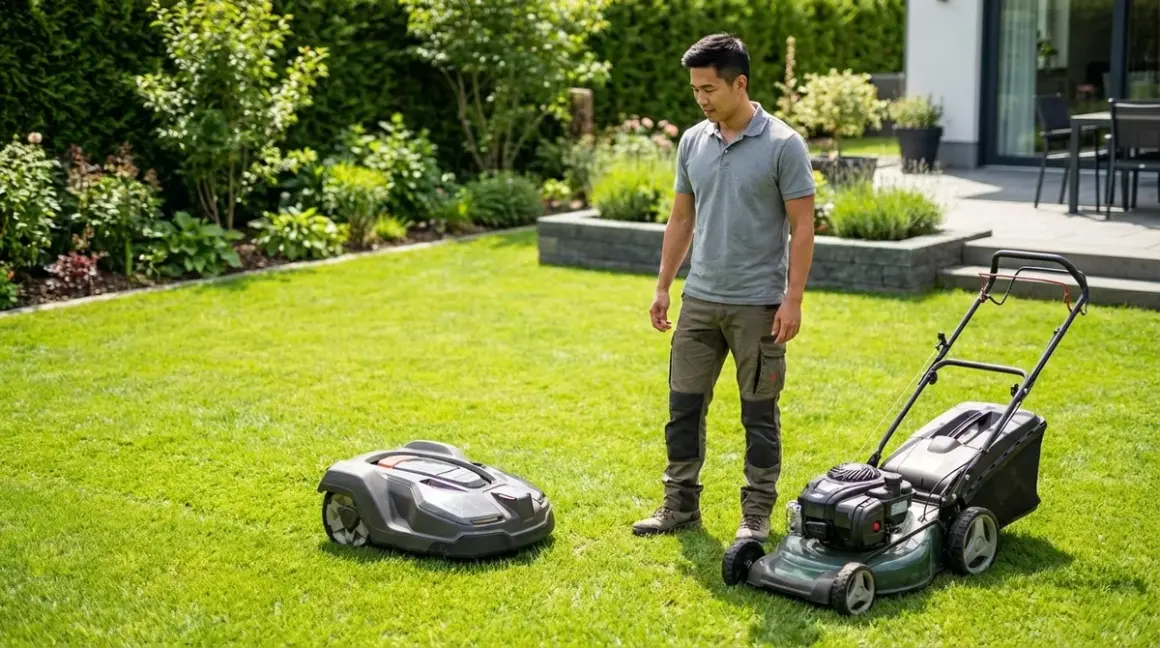

Robotic mowers handle 90% of the maintenance themselves, but traditional lawn care still wins on precision, edge work, and real-time problem-solving. The robotic mower vs traditional lawn care debate isn't about whether robots can cut grass—they absolutely can—but whether you're willing to accept their limitations in exchange for hands-off convenience. This article breaks down costs, integration complexity, reliability factors, and the real-world tradeoffs you'll face with each approach. I've helped dozens of homeowners set up smart yard automation systems, and I've learned that the "right" choice depends entirely on your yard's layout, your tolerance for troubleshooting, and how you define "good enough."
Quick Comparison
| Criteria | Robotic Mower | Traditional Lawn Care |
|---|---|---|
| Weekly time investment | 5-15 minutes (charging, obstacle checks) | 30-90 minutes (mowing, trimming, cleanup) |
| Upfront cost | $800-$4,500 for equipment + installation | $150-$500 for mower + basic tools |
| Smart home integration | Wi-Fi, Bluetooth, cellular (some Matter-compatible via 3rd-party bridges) | None native; indirect via smart irrigation controllers or scheduling automations |
| Edge and precision work | Poor to fair; requires manual trimming for clean edges | Excellent; you control every pass and detail |
| Reliability in complex yards | Struggles with slopes >25%, narrow passages, dense obstacles | Handles any terrain you can walk safely |
| Energy monitoring | Typically 20-60W during operation; trackable via smart plugs for energy monitoring on charging dock | Gas mowers: 1-2 gallons/month; electric: 500-1,500W per session |
What Are the Real Smart Home Integration Options?
Most robotic mowers operate as standalone Wi-Fi devices with proprietary apps—they're not natively compatible with Zigbee, Z-Wave, Thread, or Matter ecosystems. The Husqvarna Automower 450X EPOS🛒 Amazon connects via cellular or Wi-Fi and offers some IFTTT integration, letting you trigger basic automations like:
IF (robotic mower completes cycle) THEN (activate smart irrigation zone on north lawn)
But here's the limitation I've seen repeatedly: you're working with one-way triggers, not true two-way communication. You can't query the mower's battery state in real-time or integrate it into a Home Assistant dashboard without custom API work. In my experience, homeowners who expect seamless Matter integration the way they get with smart lights are disappointed—robotic mowers live in a different automation tier entirely.
Traditional lawn care has zero native smart home connectivity, but you can create scheduling automations around it. For example:
IF (calendar event "mow lawn" scheduled) THEN (disable smart irrigation for 3 hours before event) AND (send reminder notification to phone)
This indirect approach works surprisingly well for homeowners who already have robust smart home energy management systems in place. You're automating the ecosystem around the task, not the task itself.
Latency and Fallback Behavior
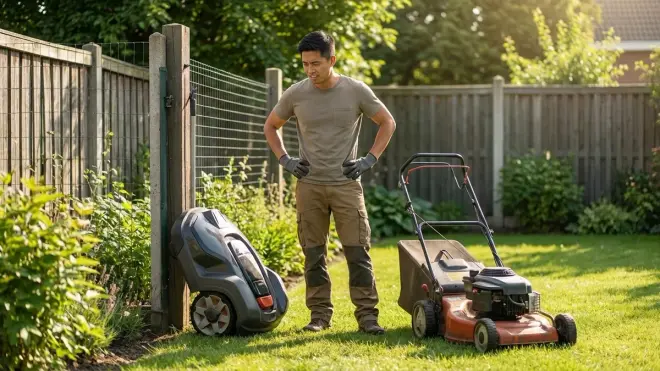
Robotic mowers with Wi-Fi connectivity typically exhibit 1-3 second latency when you issue a command from the app (pause, return to dock, schedule change). If the mower loses Wi-Fi during operation, most models default to completing their programmed schedule using onboard logic—they don't stop mid-lawn and wait for reconnection. The Worx Landroid M 20V🛒 Amazon will continue its pattern and return to the dock even if your home network crashes, which is reassuring but also means you can't remotely intervene if it's chewing through a flower bed.
Traditional mowers have instant physical control—zero latency, zero fallback concerns. You see a problem, you stop immediately. That's worth something if you have kids, pets, or unpredictable yard visitors.
How Do Costs Compare Over Five Years?
The robotic mower vs traditional lawn care cost calculation is more nuanced than "expensive upfront vs cheap ongoing." Here's how it breaks down in practice:
Robotic Mower Total Cost of Ownership
- Initial equipment: $800-$4,500 depending on lawn size and features
- Installation: $0-$1,200 if you need boundary wire trenching (some newer models use GPS/RTK instead)
- Annual blade replacement: $40-$80 (blades wear faster than traditional rotary mower blades)
- Battery replacement: $100-$300 every 2-4 years depending on model
- Electricity: approximately $20-$50 per mowing season (charging cycles)
Five-year total: $1,000-$6,500, assuming no major repairs. I've seen homeowners spend an additional $200-$400 on supplemental edge trimming tools because the mower doesn't get within 4-6 inches of obstacles.
Traditional Lawn Care Total Cost of Ownership
- Initial equipment: $150-$500 for a decent push or self-propelled mower
- Fuel or electricity: $60-$180 per season (gas models) or $15-$40 per season (electric)
- Maintenance: $30-$60 per year (blade sharpening, oil changes for gas models)
- Edge trimmer and tools: $80-$200 upfront, minimal ongoing costs
- Your time: 30-90 minutes weekly for ~25-30 weeks per season
Five-year total: $500-$1,500 in direct costs, plus approximately 62-187 hours of your time. If you value your time at $25/hour, add $1,550-$4,675 to the equation.
The math tips toward robotic mowers if you genuinely hate mowing and your yard is compatible. It tips toward traditional if you have a complex layout with lots of obstacles, steep slopes, or narrow gates that make robotic navigation frustrating.
What About Lawn Quality and Appearance?
I need to be direct here: robotic mowers produce a different aesthetic than traditional mowing. They cut using small razor blades that clip grass tips frequently (every 1-2 days), creating a mulched, golf-course-like texture. Traditional mowers cut in clean, visible stripes with a defined pass pattern—homeowners who take pride in that striped look won't get it from a robot.
Robotic mowers excel at:
- Consistent height maintenance (no "I'll mow tomorrow" overgrowth cycles)
- Natural fertilization through fine clippings that decompose quickly
- Reduced weed pressure (frequent cutting stresses broadleaf weeds)
- Quieter operation (60-70 dB vs 90-100 dB for gas mowers)
Robotic mowers struggle with:
- Edge trimming along fences, sidewalks, and foundation plantings
- Handling sticks, pinecones, or debris (they'll stop or get stuck)
- Mowing tall grass after a vacation (most max out at 3-4 inches, need a manual first cut)
- Creating intentional mowing patterns or directional aesthetics
Traditional mowing lets you respond in real-time. You see a patch of clover taking over? You can spot-treat and mow higher next time. You notice uneven growth near the sprinkler head? You adjust your pattern immediately. With a robotic mower, you're relying on scheduled algorithms that don't adapt to localized conditions unless you manually intervene.
How Reliable Are Robotic Mowers in Complex Yards?
This is where I've seen the most buyer's remorse. Robotic mowers are excellent for simple rectangular or oval lawns with minimal obstacles. They're frustrating to impossible for yards with:
- Slopes steeper than 20-25 degrees: Most models lose traction, struggle to climb, or create uneven cut patterns on steep grades
- Narrow passages: Gates or pathways narrower than 5-6 feet can confuse boundary sensors or cause navigation errors
- Dense landscaping: Flower beds, decorative rocks, or low-hanging branches require manual intervention to prevent the mower from getting stuck
- Unpredictable obstacles: Kids' toys, fallen branches, or garden hoses will stop the mower and require you to rescue it
The Segway Navimow i Series🛒 Amazon uses RTK-GPS for boundary-free navigation, which eliminates the wire installation hassle—but it still can't navigate around a forgotten soccer ball or a dog toy. In my experience, homeowners with young kids or active outdoor pets end up spending 10-15 minutes daily moving obstacles before the mower runs, which negates much of the time-saving benefit.
Maintenance and Troubleshooting
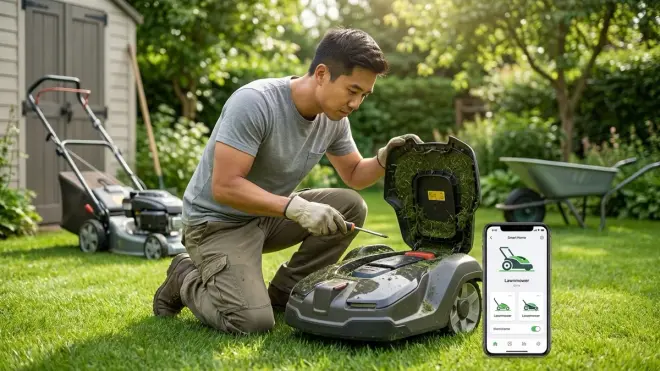
Robotic mowers require:
- Weekly checks: Clear debris from blade deck, inspect wheels for tangled grass
- Bi-weekly tasks: Wipe sensors, check boundary wire integrity (for wired models)
- Seasonal maintenance: Deep clean, firmware updates, battery health checks
Traditional mowers require:
- After each use: Clean deck, check blade condition
- Monthly: Sharpen or replace blades (for gas models: oil checks, air filter inspection)
- Seasonal: Winterization, spark plug replacement (gas models)
The robotic mower maintenance is less physically demanding, but it's ongoing and non-negotiable. Miss a sensor cleaning and the mower might wander outside its boundary or miss entire sections of lawn. Traditional mower maintenance is more intensive but less frequent, and you notice problems immediately during use rather than discovering them two days later when half your lawn is uncut.
Who Should Choose a Robotic Mower?
You're a good candidate for a robotic mower if:
- Your yard is 0.25 to 1.5 acres with minimal slopes and obstacles—robotic mowers shine in open, gently rolling lawns where navigation is straightforward.
- You value time savings over cost savings—you're willing to invest $1,500-$4,000 upfront to reclaim 2-3 hours weekly.
- You're comfortable with iterative troubleshooting—you don't mind adjusting boundary settings, tweaking schedules, or occasionally rescuing a stuck mower.
- You're already invested in smart yard automation—you have or plan to add smart irrigation, outdoor lighting, and energy monitoring systems that benefit from integrated scheduling.
In my experience, the happiest robotic mower owners are those who treat it as a "90% solution"—they accept that they'll still need to edge manually, clear obstacles occasionally, and handle special situations (first cut after vacation, overseeding periods) with traditional tools.
Who Should Choose Traditional Lawn Care?
You should stick with traditional mowing if:
- Your yard has steep slopes, narrow gates, or dense landscaping—these conditions create constant navigation failures for robotic mowers.
- You take pride in lawn aesthetics—you want striped patterns, precise edging, and the ability to adjust technique based on real-time observations.
- You have unpredictable yard traffic—kids, pets, or frequent outdoor projects mean obstacles appear daily, requiring constant pre-mowing cleanup.
- You're budget-conscious—a quality self-propelled mower and trimmer will cost under $500 and serve you reliably for 10+ years with basic maintenance.
Traditional mowing also makes sense if you're uncertain about long-term commitment. You can always start with traditional tools and migrate to robotic later once you've tested the waters with smart irrigation scheduling or other automation experiments.
Frequently Asked Questions
Can robotic mowers handle wet grass or rain?
Most modern robotic mowers are rated for operation in light rain (IP54-IP67 weatherproofing), but they shouldn't mow during heavy downpours or on saturated soil. Wet grass clippings clog blade assemblies more quickly, and traction suffers on slippery slopes. Many models include rain sensors that automatically return the mower to the dock when precipitation starts, resuming the schedule once conditions dry. Traditional mowing in wet conditions is similarly problematic—you'll get clumping, rutting, and uneven cuts regardless of approach.
Do robotic mowers work with Matter 1.4 or other smart home protocols?
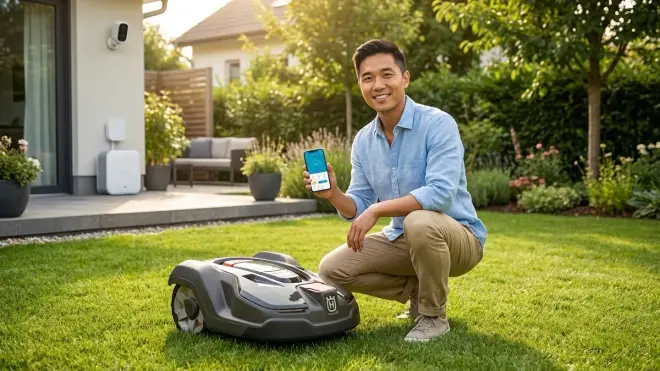
As of 2026, no major robotic mower manufacturer offers native Matter, Zigbee, Z-Wave, or Thread compatibility. Most operate as standalone Wi-Fi devices with proprietary cloud integrations. You can achieve limited smart home interaction by using IFTTT webhooks or custom Home Assistant integrations, but expect significant setup complexity and ongoing maintenance. For true integrated autonomous yard equipment, you'll need to wait for broader Matter adoption or invest in professional custom integration services—which typically cost $300-$800 for initial setup.
How long does a robotic mower battery last before replacement?
Lithium-ion batteries in robotic mowers typically deliver 2-4 years of reliable service (approximately 500-800 charge cycles) before capacity degrades noticeably. You'll start seeing shorter runtime per charge and longer charging periods as the battery ages. Replacement costs range from $100-$300 depending on model and capacity. Traditional electric mowers with removable batteries follow similar lifespans, while gas mowers avoid battery concerns entirely but introduce carburetor maintenance and fuel stability issues.
Bottom Line
The robotic mower vs traditional lawn care decision hinges on your yard's complexity and your willingness to trade precision for automation. Robotic mowers work brilliantly in simple, obstacle-free lawns where you value time savings and consistent maintenance over aesthetic control. They're frustrating in complex yards with steep slopes, narrow passages, or unpredictable obstacles. Traditional mowing offers instant adaptability, superior edge work, and zero connectivity hassles—but it demands 30-90 minutes of your time weekly.
I've installed smart home systems in homes with both approaches, and the pattern is clear: homeowners who succeed with robotic mowers treat them as a maintenance baseline, not a complete replacement. They still edge manually, they still intervene for special situations, and they've made peace with "good enough" rather than "perfect." If that sounds like acceptable compromise, a robotic mower is worth exploring. If not, there's zero shame in sticking with the traditional approach that's worked for decades—sometimes the old way is still the right way.