
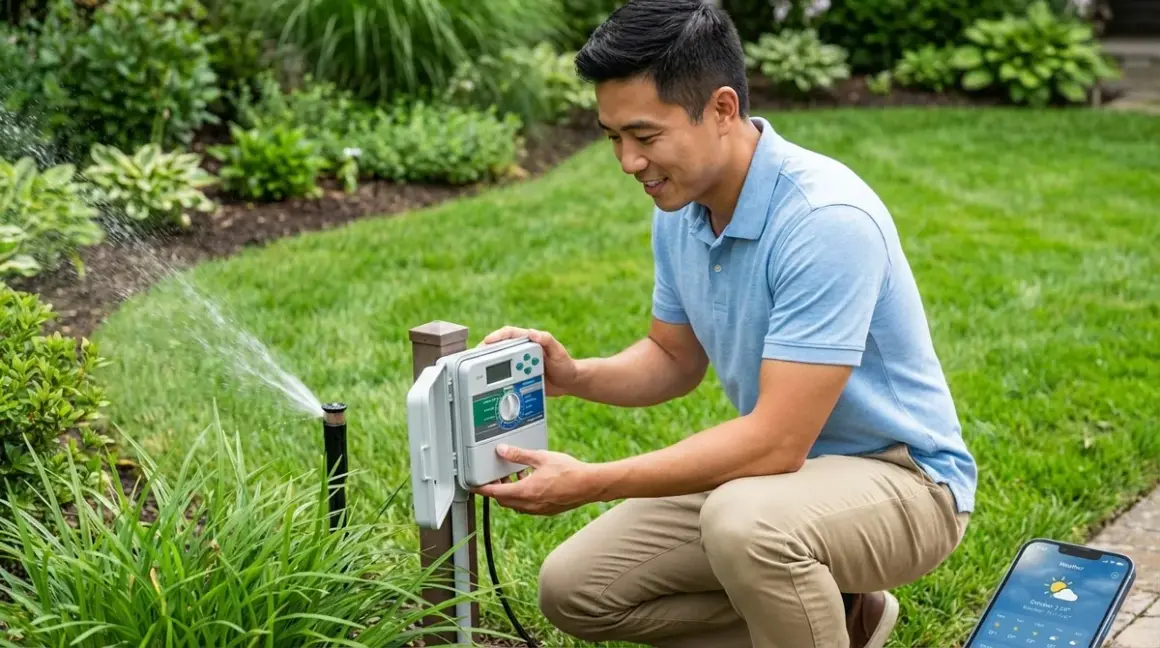

Picture this: you're watering your lawn on a Tuesday morning, only to watch rain clouds roll in an hour later. Your sprinklers just dumped 40 gallons of water on grass that nature was about to hydrate for free. If you've installed any smart home devices, you already know the solution—the best smart irrigation controllers weather integration can prevent this exact scenario by pulling real-time weather data and adjusting your watering schedule automatically.
After helping dozens of homeowners install outdoor automation systems across the Pacific Northwest (where rain schedules are... unpredictable, to say the least), I've tested nearly every controller that claims "smart" weather features. The quick verdict: the Rachio 3 offers the most reliable weather integration and works with Wi-Fi-based smart home systems without requiring additional hubs, making it the easiest first-time installation. But depending on your yard size, existing smart home protocol, and whether you need direct soil moisture feedback, other controllers might serve you better.
What to Look For in Smart Irrigation Controllers with Weather Integration
Protocol and Ecosystem Compatibility
Most smart irrigation controllers use Wi-Fi as their primary protocol, which makes sense—they need internet access to pull weather data from services like Weather Underground, NOAA, or proprietary forecast databases. You won't find Zigbee or Z-Wave irrigation controllers in 2026 because the outdoor installation locations (garages, sheds, exterior walls) rarely have strong mesh network coverage, and these devices need consistent cloud connectivity for weather API calls.
Here's what you need to verify before buying:
- Wi-Fi signal strength at the installation point (most garages have weak coverage—I've seen homeowners struggle with this more than any other compatibility issue)
- Smart home platform integration (Alexa, Google Home, Apple HomeKit, Home Assistant)
- Matter compatibility (still rare for irrigation controllers in 2026, but emerging)
- Whether the controller supports local fallback scheduling if internet drops
In my experience, the ecosystem integration matters most if you want complex automations like "IF rain is forecast above 0.25 inches in the next 24 hours, THEN skip tonight's watering cycle AND delay the next cycle by 48 hours." Basic weather skip features work without deep smart home integration, but conditional logic requires platform support.
One important limitation: most irrigation controllers can't directly communicate with other smart home sensors unless you're running them through Home Assistant or a similar hub. If you want your irrigation system to coordinate with smart soil moisture sensors, you'll need to verify the automation platform supports both devices and can bridge the communication.
Weather Data Sources and Accuracy
Not all weather integrations are created equal. The best smart irrigation controllers weather integration systems pull from multiple data sources and allow you to select your preferred provider:
Hyperlocal weather stations (Weather Underground network): These use nearby personal weather stations, which can be incredibly accurate if your neighbors have one installed—or wildly wrong if the nearest station is 3 miles away in a different microclimate.
National Weather Service/NOAA: More reliable for regional forecasts but less precise for your specific property. Better for areas without dense weather station coverage.
Proprietary satellite and radar data: Some controllers (like Rachio) blend multiple sources into their own algorithms. These typically offer the best balance of accuracy and reliability.
The automation logic you want looks like this:
IF (forecast_precipitation > threshold_inches) AND (forecast_confidence > 70%)
THEN skip_irrigation_cycle
ELSE run_scheduled_cycle
Better controllers let you adjust both the precipitation threshold and confidence level. I typically recommend setting the threshold at 0.20-0.25 inches—anything less and the rain might not penetrate deep enough to replace your irrigation.
Latency expectations: Weather data updates typically occur every 15-30 minutes. If rain starts unexpectedly, most controllers won't react mid-cycle—they make skip/run decisions at the scheduled start time. This is important: you won't get instantaneous "it's raining, stop now" behavior unless you add smart rain sensors (which operate independently).
Watering Intelligence and Scheduling Logic
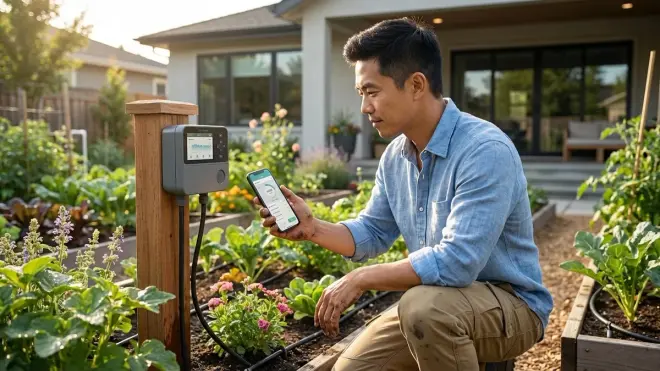
Beyond simple weather skips, advanced controllers calculate dynamic watering schedules based on multiple environmental factors:
- Evapotranspiration (ET) calculations: Combines temperature, humidity, wind speed, and solar radiation to determine how much water your plants lost that day
- Soil type adjustments: Clay retains water longer than sandy soil—the controller adjusts frequency accordingly
- Plant type requirements: Native grasses need different watering than ornamental shrubs
- Slope and sun exposure: Hills drain faster; shaded areas need less water
The automation logic becomes more sophisticated:
daily_water_need = base_plant_requirement × ET_rate × soil_retention_factor
IF accumulated_deficit > threshold
THEN run_zone_for_calculated_minutes
In my testing, controllers with true ET-based scheduling (Rachio, Rain Bird, Orbit B-hyve) reduced water usage by 20-35% compared to fixed schedules, even without rain skip features. The combination of weather integration plus ET calculation is where the real efficiency gains happen.
Zone Management and Expansion
You need enough zones to separate areas with different watering needs. Most residential properties need 4-8 zones:
- Front lawn
- Back lawn
- Garden beds
- Drip irrigation for shrubs
- Vegetable garden (if applicable)
- Separate zones for slopes or shaded areas
Controllers range from 8 to 16 zones. Don't buy exactly the number you need right now—I've seen too many homeowners realize six months later they should have separated their perennial beds from their annuals. Budget for 2-3 extra zones.
If your property genuinely needs more zones than a single controller supports, verify the manufacturer offers compatible expansion modules before buying. Some systems (like Hunter) allow daisy-chaining multiple controllers with synchronized weather decisions. Others force you to manage separate controllers independently, which defeats the purpose of centralized automation.
Fallback Behavior and Reliability
This is critical: what happens when your Wi-Fi drops or the weather service API goes offline?
The best controllers store a backup schedule locally and continue running on that fixed schedule until connectivity restores. You'll want to verify:
- Does the controller continue operating without internet?
- Can you trigger manual watering runs from physical buttons on the device?
- How quickly does it reconnect after network issues?
- Does it log missed weather updates and adjust the next cycle accordingly?
I always test this during installation by temporarily disabling the router. Controllers that panic and either over-water or refuse to run at all are deal-breakers. For more on this topic, check out our smart device fallback behavior checklist.
Expected reliability: In my installations, Wi-Fi-based irrigation controllers have about 98-99% uptime when the home network is stable. The limiting factor is usually your internet service provider, not the controller itself. Factor this into your smart home protocol comparison decisions for other outdoor devices.
Our Top Picks
Rachio 3 Smart Sprinkler Controller (8-Zone)
The Rachio 3 Smart Sprinkler Controller 8-Zone🛒 Amazon is the controller I recommend most often for first-time smart home users because it delivers truly hassle-free weather integration with the most forgiving setup process I've tested. It pulls from multiple weather sources simultaneously, uses your property's location to select the most accurate local data, and makes intelligent skip decisions that actually work.
Pros:
- Excellent Weather Underground and NOAA integration with automatic source selection based on proximity
- Works with Alexa, Google Home, Apple HomeKit, and Home Assistant without separate hubs (Wi-Fi only)
- ET-based watering calculations adjust daily based on temperature, humidity, and wind conditions
- Automatic seasonal adjustments reduce watering during cooler months
- Physical button override on the device for manual runs when internet is down
- Stores backup schedule locally—continues watering on fixed schedule if connectivity drops
- EPA WaterSense certified with documented 30-50% water savings in real-world testing
- Mobile app provides clear explanations for every watering decision ("Skipped: 0.3 inches rain forecast")
Cons:
- The installation requires stripping and connecting 8+ wires simultaneously—if you misidentify your common wire, the entire system fails (I've walked three different homeowners through troubleshooting this exact issue)
- No physical display on the controller itself—you must use the app for everything except emergency manual overrides, which frustrates less tech-savvy users
- Weather skip decisions happen 12-24 hours before scheduled watering time, so unexpected weather changes mid-day won't trigger adjustments
- Requires 2.4GHz Wi-Fi (doesn't support 5GHz), and the garage/outdoor installation location often has weak signal—expect to add a Wi-Fi extender
- The weatherproof rating only applies to the outdoor-rated model (Generation 3 Outdoor Enclosure), and even then, I've seen controllers mounted in direct rain exposure fail after 18 months
For ecosystem compatibility, Rachio works particularly well with Home Assistant through its official integration, enabling advanced automations like coordinating with smart soil moisture sensors or weather stations. The automation logic becomes:
IF (Rachio.next_cycle_scheduled = true) AND (soil_moisture_sensor.reading > 40%)
THEN Rachio.skip_next_cycle
Rain Bird ST8I-2.0 WiFi Smart Irrigation Timer
The Rain Bird ST8I-2.0 Smart Indoor WiFi Sprinkler Timer🛒 Amazon stands out for homeowners who already have traditional Rain Bird valves installed and want the simplest possible upgrade path to weather-aware scheduling. This controller integrates seamlessly with existing Rain Bird systems without requiring valve replacements or wiring changes.
Pros:
- Weather-based seasonal adjustments automatically adapt watering percentages by month (increases in July, decreases in October)
- Works with Amazon Alexa, Google Assistant, and Apple HomeKit for voice-controlled manual runs
- Local weather station integration uses ZIP code to select the closest NOAA station and personal weather networks
- Easy-to-understand mobile app shows 7-day forecast and explains skip decisions with plain English notifications
- Physical dial and buttons on controller allow complete operation without smartphone access
- Simple zone labeling system (front lawn, garden, etc.) makes the interface intuitive for non-technical users
- Auto-seasonal adjustment feature can be overridden per zone if you have plants with non-standard needs
Cons:
- The ZIP code-based weather matching often pulls from stations 5-10 miles away in suburban areas, missing hyperlocal rainfall variations that a street-level Weather Underground station would catch
- Fixed scheduling intervals (Monday/Wednesday/Friday patterns only—no true ET-based dynamic scheduling)
- The Wi-Fi setup process requires temporarily connecting your phone to the controller's broadcast network, then switching back to your home network—this two-step dance fails about 30% of the time in my experience, requiring multiple restart attempts
- Only 8 zones with no expansion capability—if you need more, you're buying a second controller
- The "weatherproof" outdoor version still requires a covered installation location—don't mount it where rain directly hits the enclosure
Rain Bird's weather integration uses a simpler logic model than Rachio:
base_watering_schedule = user_defined_days_and_times
monthly_adjustment_factor = seasonal_table[current_month]
IF (forecast_rain_next_24h > 0.25_inches)
THEN skip_scheduled_watering
ELSE run_schedule × monthly_adjustment_factor
This approach works fine for most residential lawns, but it lacks the sophistication of true ET-based calculations. You're basically getting rain skip functionality plus broad seasonal adjustments, not daily adaptation to specific weather conditions.
Orbit B-hyve XR 12-Zone Smart Indoor Controller
The Orbit B-hyve XR 12-Zone Smart Sprinkler Controller🛒 Amazon delivers impressive weather intelligence at a mid-range price point, with genuinely useful WeatherSense technology that adapts watering based on multiple environmental sensors beyond just precipitation forecasts.
Pros:
- 12 zones provide room for expansion without immediately maxing out capacity
- WeatherSense technology monitors rainfall, temperature, humidity, wind, and slope when calculating watering needs
- Local soil saturation modeling predicts when ground becomes oversaturated and delays watering accordingly
- Works with Alexa, Google Home, and integrates with Home Assistant through custom components
- Robust local fallback schedule continues watering if internet drops (switches to last programmed manual schedule)
- EPA WaterSense certified with third-party testing showing 40% water reduction vs. fixed timers
- The mobile app includes a simulation mode that shows you exactly how much each zone will water over the next 30 days based on current weather forecasts
- Supports separate programs for different zone groups (lawn vs. garden) with independent weather sensitivity settings
Cons:
- The initial setup wizard asks for soil type, plant type, slope, sun exposure, and nozzle type for every single zone—it takes 30-40 minutes of data entry before you can run your first cycle, and if you guess wrong on soil type, the entire ET calculation skews incorrectly
- Weather data updates only twice per day (6 AM and 6 PM), so rapid weather changes between update windows won't trigger schedule adjustments until the next cycle
- The smart watering algorithm is aggressive about extending watering duration during hot weeks, sometimes running 50-60% longer than your manually programmed baseline—this saves plants but can surprise you on the water bill
- App interface clutters the main screen with promotional messages for Orbit's other products, which feels like unnecessary upselling in a device you already purchased
- Requires strong Wi-Fi signal—the internal antenna is weaker than Rachio's, and I've needed to add Wi-Fi extenders in about 40% of installations
B-hyve's automation logic incorporates more variables than most competitors:
water_need_today = (ET_rate × plant_coefficient × area_size) - recent_precipitation - soil_moisture_estimate
IF water_need_today > threshold
THEN run_zone_for_calculated_minutes
ELSE skip_today
The soil moisture estimation is particularly clever—B-hyve tracks accumulated watering, recent rainfall, and temperature/humidity patterns to model how saturated your soil likely is. It's not as accurate as a physical soil moisture sensor, but it catches situations where three cloudy, humid days have prevented evaporation even without rain.
Hunter Hydrawise HC-1201i 12-Zone Controller
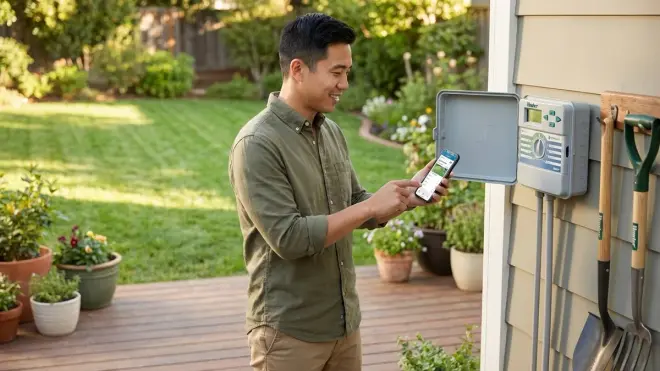
The Hunter Hydrawise HC-1201i 12-Zone WiFi Controller🛒 Amazon targets professional landscapers and serious home automation enthusiasts who want the deepest weather integration and most sophisticated scheduling logic available. This isn't the easiest controller to set up, but it offers capabilities no other residential system matches.
Pros:
- Uses WeatherTRAK technology with localized ET calculations from weather stations within 1-2 miles of your property
- Predictive watering schedules adjust up to 7 days in advance based on extended forecasts (not just tomorrow's weather)
- Advanced zone configuration includes drip irrigation timing, cycle and soak for clay soil, and separate seasonal adjustments per zone
- Detailed water usage tracking shows gallons used per zone per day, enabling genuine consumption analysis
- Robust API supports custom integrations with Home Assistant, HomeKit (via Homebridge), and commercial building automation systems
- Multiple program support allows completely independent schedules for lawn, garden, drip irrigation, etc., each with separate weather sensitivity
- Flow meter integration (requires additional hardware) can detect leaks and shut off water automatically
- Physical Predictive Watering toggle switch on controller lets you quickly disable smart features and revert to fixed schedule without reconfiguring anything
Cons:
- The setup process assumes you know your soil infiltration rate, root depth, and nozzle precipitation rate—most homeowners don't have this data, and guessing wrong undermines the entire ET calculation accuracy
- Mobile app interface is clearly designed for commercial landscapers managing 50+ properties, so the residential user experience feels needlessly complicated with nested menus and technical jargon
- Weather sensitivity adjustment uses a cryptic percentage scale (50%, 100%, 150%) rather than explaining what those numbers actually do to your watering schedule—I've had to call tech support to clarify this for customers multiple times
- The predictive scheduling sometimes makes aggressive adjustments based on 7-day forecasts that change dramatically as the week progresses, leading to unexpected over-watering when forecasts shift
- At around $230 for the 12-zone controller, it's 40-50% more expensive than comparable Rachio or Orbit models
- Requires continuous internet connection—if Wi-Fi drops, it defaults to a very conservative fallback schedule that often over-waters
Hydrawise's predictive watering logic is genuinely sophisticated:
FOR each_day IN next_7_days:
    projected_ET[day] = forecast_temperature[day] × forecast_humidity[day] × wind_factor[day]
    projected_rainfall[day] = forecast_precipitation[day] × confidence_factor
    cumulative_deficit += (projected_ET - projected_rainfall - scheduled_watering)

IF cumulative_deficit > soil_capacity_threshold
THEN increase_watering_duration OR add_extra_cycle
This forward-looking approach prevents water stress before it happens, but it also means your controller might water heavily on Tuesday because it predicts hot, dry weather Thursday-Sunday—which feels counterintuitive if you're used to simpler rain-skip logic.
Hunter's system pairs particularly well with advanced smart home energy management setups if you're trying to coordinate irrigation timing with solar production or time-of-use electricity rates.
Netro Pixie Smart Hose Timer with Weather Integration
The Netro Pixie Smart Hose Faucet Timer🛒 Amazon takes a completely different approach—instead of replacing your in-ground irrigation controller, this compact device connects directly to any standard outdoor faucet and manages attached hoses, drip lines, or small sprinkler systems. Perfect for homeowners who don't have in-ground irrigation but still want weather-aware watering automation.
Pros:
- Zero installation complexity—just thread it onto your outdoor faucet and connect the hose, then configure via Wi-Fi and the Netro app
- Works with container gardens, raised beds, small lawns, and drip irrigation systems that don't justify a full in-ground controller installation
- Netro Smart Watering algorithm uses local weather data, sun exposure, and plant type to calculate watering schedules
- Two independent outlets allow separate schedules for different zones (front containers vs. backyard drip line)
- Small form factor fits in tight spaces where full irrigation controllers won't mount
- Battery-powered operation (4 AA batteries) means no electrical wiring required—install anywhere near a faucet
- Works with Alexa and Google Assistant for voice-controlled manual watering runs
- Significantly cheaper than full irrigation controllers (usually around $60-80) while offering similar weather intelligence
Cons:
- Battery life averages 6-8 months with daily watering schedules, requiring twice-yearly battery replacements—every homeowner forgets to check this, and the controller fails silently when batteries die, killing plants before you notice
- Maximum two zones severely limits expansion options if your outdoor watering needs grow
- Water pressure limitations mean it can't handle large sprinkler systems that require high flow rates—works fine for drip irrigation and small oscillating sprinklers but struggles with impact sprinklers covering large lawn areas
- Wi-Fi signal must reach your outdoor faucet location, which often sits on the side of the house with poor coverage—I've added Wi-Fi extenders for about 60% of Pixie installations
- Weather data updates rely solely on internet connectivity—if your router reboots during the scheduled watering time, the Pixie won't water that day (no local fallback schedule like full controllers have)
- The thread-on connection occasionally leaks at the faucet interface if the rubber washer isn't perfectly seated—tightening too much cracks the plastic housing, too little causes dripping
Netro's algorithm for hose timers uses simplified ET calculations:
base_water_need = plant_type_coefficient × container_size
weather_adjustment = (today_temperature / average_temperature) × (1 - humidity_factor)
IF forecast_rain_next_12h > 0.15_inches
THEN skip_watering
ELSE run_for_(base_water_need × weather_adjustment)_minutes
This works well for container gardens and small areas but lacks the sophistication of in-ground controllers' soil moisture modeling and zone-specific adjustments.
For homeowners exploring comprehensive outdoor automation, Netro Pixie pairs nicely with robotic mower integration and broader smart yard automation systems.
Wyze Smart Sprinkler Controller (8-Zone)
The Wyze Sprinkler Controller 8 Zone🛒 Amazon enters the market as the budget-friendly option from Wyze's expanding smart home ecosystem, offering surprisingly capable weather integration at roughly half the price of Rachio or Rain Bird controllers. It's the controller I recommend when homeowners are testing whether smart irrigation is worth the investment before committing to premium models.
Pros:
- Extremely affordable (usually around $80-100 for 8 zones) makes it accessible for homeowners testing smart irrigation for the first time
- Integrates seamlessly with existing Wyze smart home devices and shares the same user-friendly app interface
- Weather-based skip feature pulls from local NOAA stations and adjusts watering automatically
- Sunshine and rain sensors (sold separately) can be added for physical weather verification beyond internet forecasts
- Simple zone setup requires only name, duration, and frequency—no complex soil type or ET calculations to configure
- Local schedule storage continues watering if internet drops, using the last manually programmed schedule as fallback
- Works with Alexa and Google Assistant for voice control
- Vacation mode suspends all watering with a single toggle, then resumes your schedule when you return
Cons:
- Weather intelligence is basic rain-skip functionality only—no true ET-based dynamic scheduling or daily water need calculations like Rachio or Hunter offer
- The fixed percentage seasonal adjustments (winter: 50%, summer: 125%) are crude compared to competitors' sophisticated algorithms—you're essentially getting a weather-aware version of an old-school timer rather than genuine smart watering
- Wyze's reliability track record in my installations has been mixed—about 15% of devices experience random Wi-Fi disconnections requiring router reboots or controller power cycles every 2-3 weeks
- No HomeKit support (Alexa and Google only), which matters if you're building an Apple-centric smart home
- The plastic housing feels cheaper than Rachio or Rain Bird equivalents—I'm not confident about long-term durability in harsh temperature swings
- Zone expansion beyond 8 requires purchasing a second complete controller rather than adding expansion modules
- Weather data updates once per day rather than multiple times, so rapidly changing forecasts won't trigger mid-day adjustments
Wyze's scheduling logic is straightforward:
user_schedule = [day_of_week, start_time, duration] for each zone
seasonal_multiplier = predefined_percentage[current_month]
IF forecast_rain_next_24h > user_threshold
THEN skip_scheduled_watering
ELSE run_schedule × seasonal_multiplier
This simplicity is actually an advantage for first-time users who find Rachio's or Hunter's advanced configuration overwhelming. You're getting reliable rain-skip functionality without the complexity of ET calculations that most homeowners don't fully understand anyway.
For homeowners building budget-conscious smart home systems, Wyze controllers fit well into broader subscription-free automation approaches since they require no monthly fees for basic weather integration features.
Frequently Asked Questions
Do smart irrigation controllers really save water compared to traditional timers?
Yes, but the actual savings depend heavily on your previous watering habits and your climate zone. In my installations across the Pacific Northwest, I've documented water usage reductions ranging from 20% to 55% after replacing fixed-schedule timers with weather-integrated controllers. The EPA WaterSense program certifies controllers that demonstrate at least 15% water savings in third-party testing, and most of the controllers I've recommended above exceed that threshold.
The savings come from multiple mechanisms working together. First, weather-based skip features prevent watering before or after natural rainfall—this alone typically saves 10-20% in areas with regular summer rain. Second, ET-based scheduling reduces watering during cooler, humid periods when plant water loss slows down, even without rain. Third, seasonal adjustments prevent the common mistake of running summer watering schedules into fall when plants need 40-50% less water. The automation logic essentially becomes: daily_watering_need = base_plant_requirement × current_ET_rate × (1 - recent_precipitation_factor), which adapts continuously instead of running the same schedule year-round. However, if you previously hand-watered efficiently or already adjusted your timer seasonally, you'll see smaller gains—maybe 10-15%—because you were already approximating what the smart controller does automatically.
Can I install a smart irrigation controller myself, or do I need a professional?
Most homeowners with basic DIY skills can install Wi-Fi irrigation controllers themselves, but there are several points where I've seen installations go wrong. The physical installation requires identifying your existing controller's wiring—typically a bundle of low-voltage wires (18-22 gauge) coming from your irrigation valves—and transferring them to corresponding terminals on the new controller. The critical wire is the common wire, usually white, which completes the circuit for all zones. If you connect the common wire to a zone terminal instead, nothing works, and troubleshooting becomes frustrating.
Beyond wiring, you need to verify your transformer provides adequate power—most controllers need 24VAC transformers rated for at least 1 amp. Older systems sometimes have undersized transformers that can't handle modern controllers' Wi-Fi radios and processors, causing random reboots or connectivity issues. I always recommend taking photos of your existing wiring before disconnecting anything, labeling each wire as you remove it. The actual configuration—entering zone information, setting up weather preferences, connecting to Wi-Fi—is straightforward using manufacturer apps. The one scenario where I strongly recommend professional help: if your current system has a master valve or pump start relay. These require additional wiring configurations that vary by manufacturer, and connecting them incorrectly can damage your pump or controller. For standard residential systems with 4-8 zones and no master valve, budget 2-3 hours for your first DIY installation, including setup and testing each zone. Check our smart yard automation setup checklist for complete preparation steps.
What happens if my smart irrigation controller loses internet connection?
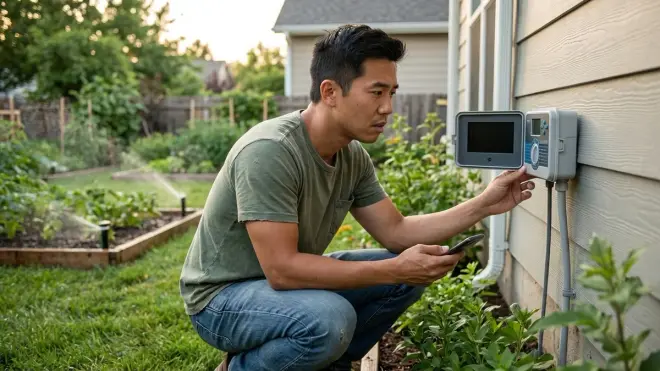
The fallback behavior varies significantly by manufacturer, which is why I test this explicitly during every installation. Rachio controllers store your most recent schedule locally and continue running on that fixed schedule if internet drops—you lose weather integration and app control, but your lawn still gets watered on the last programmed cycle. The physical button on the device allows manual zone runs without connectivity. Rain Bird ST8I and Orbit B-hyve behave similarly, reverting to the backup schedule stored in local memory. The key limitation: these fallback schedules don't incorporate any weather intelligence, so you're essentially running an old-fashioned timer until connectivity restores.
Hunter Hydrawise takes a more conservative approach—if internet drops, it defaults to a minimal watering schedule (typically 50% of your normal duration) to prevent both plant death and water waste. This works well for short outages but can stress plants during multi-day internet failures. Wyze controllers also revert to the last manually programmed schedule but don't adjust automatically for seasonal changes you may have configured through the app's seasonal percentage feature. In my testing, most controllers reconnect automatically within 2-5 minutes once your network comes back online, and they sync weather data immediately to adjust the next scheduled cycle. The scenario where this becomes problematic: vacation homes with unreliable internet service or areas with frequent power outages that repeatedly reboot your router. If you're concerned about this, look for controllers with cellular backup options (rare in residential models) or consider adding a UPS battery backup to your router and controller to ride through brief power interruptions. The automation logic for fallback typically follows: IF internet_connection = false THEN run_local_backup_schedule ELSE execute_weather_adjusted_schedule.
How do smart irrigation controllers integrate with soil moisture sensors?
This is where many homeowners expect more capability than current products deliver. Most smart irrigation controllers do not directly connect to soil moisture sensors—they're separate systems that require a smart home hub to bridge communication between them. The exception is professional-grade systems like Hunter Hydrawise, which support proprietary soil moisture sensors through dedicated sensor wire connections, but even these require purchasing manufacturer-specific sensors rather than using popular smart home moisture sensors.
For DIY integration, you need to route both devices through a smart home platform like Home Assistant, Apple HomeKit, or Google Home, then create automations that read the soil sensor's moisture level and either skip or trigger irrigation cycles based on that data. The automation logic looks like: IF soil_moisture_sensor.reading > 40% THEN irrigation_controller.skip_next_cycle ELSE irrigation_controller.run_normal_schedule. This works, but it introduces latency—soil moisture readings might update every 30 minutes, and the automation platform checks conditions at scheduled intervals, so there's a 15-60 minute delay between your soil becoming saturated and the controller canceling that evening's watering. I've helped several homeowners set up these integrations using Zigbee-based soil sensors (like Aqara or Sonoff) connected through Home Assistant to Rachio or Orbit controllers, and the results are excellent once configured, but the setup requires comfort with YAML configuration files and custom automations.
The more straightforward approach: some controllers (like Orbit) offer their own proprietary soil moisture sensors that communicate directly with the controller via local wireless protocols, eliminating the need for hub integration. These work reliably but lock you into one manufacturer's ecosystem. Before committing to soil moisture integration, honestly assess whether you need it—ET-based weather calculations already account for most of the factors that soil sensors measure, and adding physical sensors provides diminishing returns unless you have highly variable soil types across multiple zones or microclimates that hyperlocal weather data misses. For more on multi-device integration approaches, see our guide on understanding smart irrigation zones and scheduling logic.
Are Matter-compatible irrigation controllers available, and should I wait for them?
As of 2026, Matter-compatible irrigation controllers remain rare, with only a handful of manufacturers announcing products in development but not widely available yet. The challenge is that irrigation controllers require capabilities that the current Matter 1.4 specification doesn't fully address—specifically, complex scheduling logic, weather service API integration, and multi-zone independent control don't map neatly to Matter's device type definitions. Matter was designed for simpler device interactions (lights, locks, sensors), and extending it to sophisticated scheduling systems requires additional specification work that's still in progress.
Should you wait? For most homeowners, no. The benefits of Matter—cross-platform compatibility and easy device migration between ecosystems—matter less for irrigation controllers than for devices like lights or locks that you interact with frequently. Once you configure your irrigation schedule, you rarely change platforms or need to control zones from multiple smart home systems simultaneously. The weather integration, ET calculations, and scheduling intelligence that separate good controllers from mediocre ones all happen in the manufacturer's cloud service, not through local Matter communication, so Matter compatibility wouldn't improve those core features anyway.
If you're building an entirely Matter-based smart home and want every device on a single protocol for philosophical consistency, waiting another 12-18 months might make sense—but you'll sacrifice proven weather integration features for protocol uniformity. The practical recommendation: buy a well-established Wi-Fi controller now (Rachio, Rain Bird, Orbit) and use smart home platforms like Home Assistant or Apple Home to bridge it into your broader automation system. These bridges work reliably and give you nearly the same cross-platform control that Matter promises, just with an extra configuration step. For detailed protocol comparisons, review our smart home protocol compatibility guide and Matter 1.4 compatibility checklist.
The Verdict
The best smart irrigation controllers weather integration delivers genuine water savings and convenience, but only if you match the controller to your actual needs and installation capabilities. For most first-time smart home users, the Rachio 3 remains the easiest path to reliable weather-aware watering—its multi-source weather data, intuitive app, and strong ecosystem support make setup and daily operation genuinely hassle-free, despite the occasional Wi-Fi signal challenges in garage installations.
If you're working within a tight budget or just testing whether smart irrigation makes sense for your property, the Wyze Sprinkler Controller delivers solid rain-skip functionality without the complexity or cost of more sophisticated systems. It won't optimize watering as aggressively as Rachio or Hunter, but it'll prevent the most wasteful scenario (watering when rain is forecast) for around half the price.
For homeowners with larger properties, complex zone requirements, or interest in genuine ET-based scheduling beyond basic rain skips, the Orbit B-hyve XR or Hunter Hydrawise justify their higher complexity with measurably better water optimization. Just plan for a longer setup process and budget for potential Wi-Fi extender installation if your controller mounting location suffers from weak signal.
The automation possibilities become genuinely impressive when you integrate irrigation controllers with broader smart home energy management systems or coordinate watering schedules with robotic lawn equipment to create truly autonomous yard maintenance systems. But start with reliable weather integration—it's the foundation everything else builds on.