
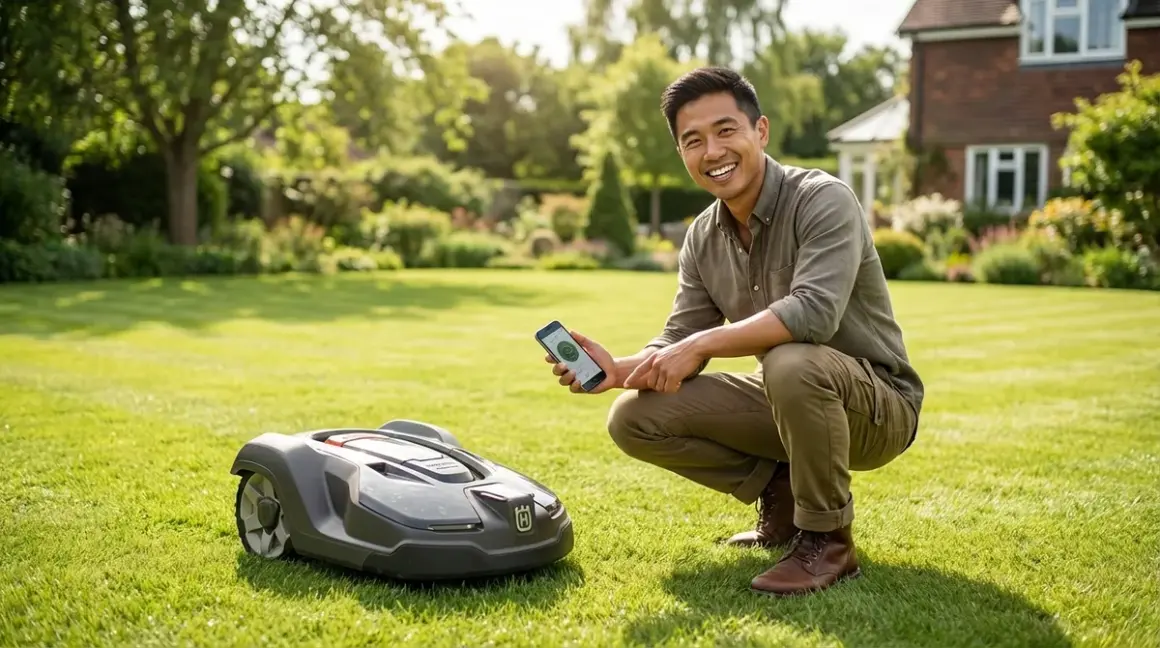

You've got a lawn that stretches half an acre or more, and pushing a mower for an hour every weekend isn't how you want to spend your time. The best smart robotic lawn mowers for large yards handle the grunt work while you control them from your phone—but getting one that actually covers your property reliably requires careful protocol matching and realistic expectations about connectivity. Quick verdict: If you need true large-yard coverage (1+ acres), prioritize models with RTK GPS or built-in cellular connectivity—standard Wi-Fi will leave you with dead zones and incomplete cuts.
In my experience installing outdoor smart devices across the Pacific Northwest, I've watched homeowners struggle with robotic mowers that promise seamless coverage but can't maintain a connection beyond 50 feet from the router. Large yards present unique challenges: Wi-Fi dead zones, perimeter wire installation across complex terrain, and integration friction when you try to coordinate mowing schedules with smart irrigation controllers or other yard automation systems.
This guide breaks down what actually matters when you're shopping for the best smart robotic lawn mowers for large yards—not just cutting width and battery specs, but the protocols, hub requirements, and automation logic that determine whether your mower becomes a reliable part of your smart yard ecosystem or an expensive paperweight.
What to Look For in Smart Robotic Lawn Mowers for Large Yards
1. Connectivity Protocol and Range Limitations
Most robotic mowers use Wi-Fi (2.4 GHz) for app control and cloud connectivity, but large yards expose Wi-Fi's fundamental weakness: range. A typical home router reaches 150-200 feet outdoors in ideal conditions—less if you have trees, landscaping, or terrain elevation changes.
If your property exceeds 0.5 acres, you need one of three solutions:
- Built-in cellular connectivity (LTE/4G)—the mower maintains its own connection independent of your home network
- RTK GPS navigation—reduces dependency on constant cloud connection for navigation (the mower can operate semi-autonomously)
- Wi-Fi mesh extenders rated for outdoor use, strategically placed to cover your mowing zone
In my experience, homeowners underestimate how much foliage and terrain affect signal strength. I've seen setups where the mower worked perfectly in spring but lost connection in summer when the trees leafed out.
Important compatibility note: Robotic mowers do NOT use Zigbee, Z-Wave, Thread, or Matter protocols as of 2026. They're Wi-Fi or cellular devices that connect to your smart home ecosystem through cloud-to-cloud integration (Amazon Alexa, Google Home, Apple HomeKit) or via API calls if you're running Home Assistant. This means your automation logic runs through internet servers, not locally—expect 2-5 second latency for manual commands and cloud dependency for all remote control features.
2. Coverage Capacity vs. Real-World Terrain
Manufacturers list maximum acreage ratings, but these assume flat, obstacle-free lawns. Real yards have slopes, tree roots, flower beds, and irregular shapes that reduce effective coverage by 20-30%.
Key specifications to evaluate:
- Slope tolerance (measured in degrees or percentage)—most handle 15-20° slopes; premium models manage up to 35°
- Cutting width—wider decks (10-12 inches) cover ground faster but struggle in tight spaces
- Battery runtime vs. recharge time—large-yard mowers should run 2-3 hours and recharge in under 90 minutes
For properties over 1 acre, look for models that support multi-zone programming. This lets you create separate mowing schedules for front and back yards or high-traffic vs. low-traffic areas. The automation logic looks like this:
IF (current_day == "Monday" AND time == "10:00 AM") THEN
  mow_zone("backyard", cutting_height=3.0_inches, pattern="random")
ELSE IF (current_day == "Thursday" AND time == "08:00 AM") THEN
  mow_zone("front_yard", cutting_height=2.5_inches, pattern="parallel_lines")
END IF
3. Perimeter Definition Method: Wire vs. GPS vs. Vision
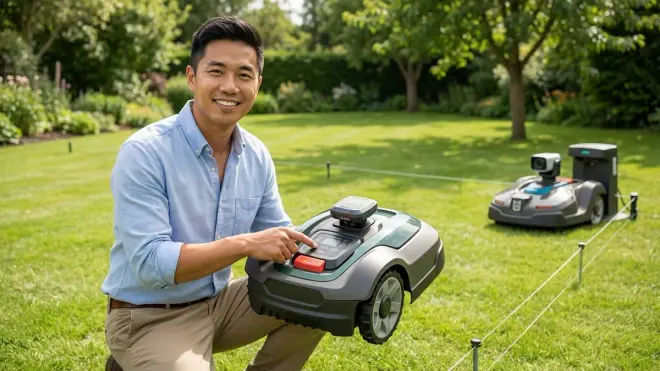
Large yards make perimeter wire installation a significant project. You'll need to bury or stake wire along every boundary, around flower beds, and near fences—often 500-1,000+ feet of wire for properties over 0.75 acres.
Three perimeter systems:
- Boundary wire (most common)—requires physical installation but works reliably regardless of signal conditions; expect 4-8 hours of labor for initial setup
- RTK GPS (premium models)—you walk the perimeter once with a handheld controller; the mower maps boundaries via satellite positioning with ±1-inch accuracy; no wire installation but requires clear sky view (struggles under heavy tree cover)
- Vision-based AI (emerging technology)—cameras and sensors identify lawn edges, but reliability drops significantly on properties with ambiguous boundaries like gradual transitions to naturalized areas
Fallback behavior matters: If the mower loses GPS signal or boundary wire connection, does it stop immediately or continue until it hits a physical obstacle? In my installations, I've seen vision-based mowers wander into gravel driveways when lighting conditions changed. Wire-based systems offer the most predictable failure mode—the mower stops when it reaches the wire, period.
4. Smart Home Integration Depth and Automation Options
"Works with Alexa" doesn't tell you much. Here's what you actually need to know about integration:
Basic integration (most models):
- Voice commands: "Alexa, start the mower" / "Hey Google, pause the mower"
- App-based scheduling and manual control
- Push notifications for completion, errors, or maintenance needs
- Latency: 3-8 seconds from voice command to mower action (cloud round-trip)
Advanced integration (premium models or Home Assistant setup):
- Weather API integration—automatically skip mowing if rain is forecast within 3 hours
- Soil moisture sensor coordination—delay mowing if irrigation ran recently and grass is wet
- Energy management—charge during off-peak hours if you're on time-of-use electricity rates (see our guide on peak and off-peak energy automation)
- Security system coordination—disable mowing schedules when you're home but the yard is occupied (kids playing outside)
The automation logic for weather integration might look like:
IF (weather_forecast.next_3_hours.precipitation_probability > 60%) THEN
  cancel_scheduled_mow()
  reschedule_for(time = current_time + 6_hours)
ELSE
  execute_scheduled_mow()
END IF
Critical limitation: Because robotic mowers don't use local smart home protocols, your automations MUST have internet connectivity to function. If your home internet goes down, you can't trigger mowing via app or voice—only the mower's onboard schedule will continue. This is fundamentally different from Zigbee or Z-Wave devices that can run locally through a hub.
5. Maintenance Requirements and Sensor Reliability
Large-yard mowers run longer and cut more grass, which means more frequent blade replacement and cleaning. Expect to replace cutting blades every 2-3 months during growing season—some models use small pivoting blades (replaced in sets of 3-6), others use fixed bar blades (replaced as a single unit).
Sensors that affect reliability:
- Lift sensors—stop blades immediately if the mower is picked up or tips over
- Collision sensors—detect obstacles and change direction (optical, ultrasonic, or physical bumpers)
- Rain sensors—send the mower back to the charging dock when precipitation starts
I've seen homeowners frustrated by overly sensitive rain sensors that abort mowing sessions because of morning dew or sprinkler overspray. Better models let you adjust sensor thresholds or disable rain detection entirely—useful if you're coordinating with smart irrigation systems that water at predictable times.
6. Security Features and Theft Prevention
A $1,500-$3,500 robot sitting in your yard attracts attention. PIN lock and GPS tracking are non-negotiable for large yards where the mower operates far from the house and may not be visible from windows.
Security features to prioritize:
- PIN lock—mower won't operate without entering a code on its keypad
- GPS tracking—you can locate the mower via app if it's stolen (requires cellular or active Wi-Fi connection)
- Geofencing alerts—you receive a notification if the mower leaves your property boundaries
- Lift alarms—audible alarm sounds if someone picks up the mower while it's operating
Fallback consideration: If the mower is stolen and taken out of Wi-Fi range, GPS tracking only works if the model has built-in cellular connectivity. Wi-Fi-only models become untraceable once they're off your network.
Our Top Picks for Large-Yard Smart Robotic Mowers
Husqvarna Automower 450X EPOS
The Husqvarna Automower 450X EPOS🛒 Amazon is the most reliable large-yard mower I've installed, designed for properties up to 1.25 acres with RTK GPS boundary definition that eliminates perimeter wire installation. It uses satellite-based positioning with a reference station you place in your yard, achieving ±1-inch boundary accuracy even on complex properties with irregular shapes.
Pros:
- No perimeter wire required—you walk the boundary once with a handheld controller to define mowing zones
- Built-in cellular connectivity (LTE)—maintains cloud connection independent of home Wi-Fi for reliable app control and GPS tracking
- Handles slopes up to 24°—works on most residential terrain without traction issues
- Multi-zone programming with separate schedules—define different cutting heights and frequencies for up to 10 zones
- Weather API integration—automatically adjusts mowing schedule based on forecast (requires subscription after first year)
- Excellent smart home integration—Alexa, Google Home, and IFTTT support for custom automations
Cons:
- Requires cellular subscription after first year (around $10-15/month)—without it, you lose GPS tracking, remote app control, and weather integration
- Reference station needs clear sky view—GPS accuracy degrades under heavy tree cover or near tall structures
- The companion app is occasionally laggy—I've seen 5-10 second delays when loading mowing history or adjusting schedules during peak usage times
The EPOS uses a reference station that you mount on your roof or in an open area of your yard—it receives satellite signals and transmits correction data to the mower for precise positioning. This is the same technology used in precision agriculture and surveying. If you have sections of your property with dense tree canopy, the mower may struggle with boundary precision in those areas (±6 inches instead of ±1 inch).
Automation logic example for multi-zone coordination:
IF (soil_moisture_sensor.zone_1 < 30%) THEN
  skip_mowing_zone_1()
  log_event("Skipped Zone 1 - soil too dry")
ELSE IF (time == "07:00 AM" AND day_of_week == "Monday") THEN
  mow_zone(zone_1, cutting_height=3.0_inches, pattern="systematic")
END IF
Worx Landroid Pro WR147E
The Worx Landroid Pro WR147E🛒 Amazon offers the best value for homeowners with 1-acre properties who are willing to install boundary wire, with excellent app-based zone management and reliable Wi-Fi connectivity when paired with outdoor mesh extenders.
Pros:
- Covers up to 1 acre on a single charge—3-hour runtime with 90-minute recharge cycle
- AIA (Artificial Intelligence Algorithm) navigation—learns your yard layout over time and optimizes mowing patterns for efficiency
- Modular accessory system—add GPS module, 4G/LTE module, or voice control module as needed
- Cut-to-edge design—10-inch cutting width with offset blade placement gets within 1 inch of boundary wire
- Works with Home Assistant—local API access available for custom automations without cloud dependency
- Handles narrow passages down to 24 inches—better than most large-yard mowers for properties with side yards or gate areas
Cons:
- Requires boundary wire installation—budget 4-6 hours for a typical 1-acre property or pay for professional installation
- Wi-Fi range limitations—you'll likely need outdoor mesh extenders for properties over 0.5 acres (I've had success with Ubiquiti outdoor APs placed strategically)
- Rain sensor is overly sensitive—frequently returns to dock during heavy dew; you'll want to disable it if you're coordinating with irrigation schedules
The modularity is genuinely useful—you can start with the base model and add the 4G module later if you realize Wi-Fi coverage isn't sufficient. The GPS module (separate purchase, around $100) provides theft tracking but doesn't affect navigation (this mower still uses boundary wire for perimeter definition).
For Home Assistant users, local API access means your automations can run without internet:
IF (sensor.landroid_battery_level < 20%) THEN
  notify.send("Landroid battery low - check for wire break or obstacle")
ELSE IF (sensor.outdoor_temperature > 95°F) THEN
  service.call("worx_landroid.pause")
  schedule_resume(time = 18:00)  # Resume when temperature drops in evening
END IF
Segway Navimow i105E
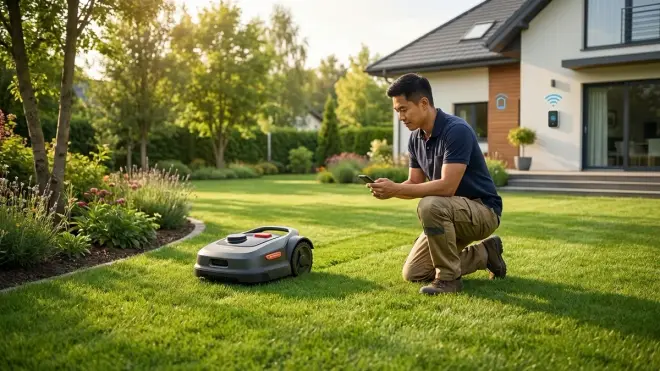
The Segway Navimow i105E🛒 Amazon uses EFLS (Exact Fusion Locating System) that combines GPS, GLONASS, BeiDou, and Galileo satellite positioning—no boundary wire and no separate reference station required, making it the easiest large-yard setup I've encountered.
Pros:
- True wireless perimeter setup—no wire installation, no reference station; you walk the boundary with the mower itself
- Works in areas with moderate tree cover—multi-constellation GNSS provides better signal reliability than GPS-only systems
- Handles up to 1.25 acres with systematic parallel-line mowing patterns that look professional
- Real-time obstacle detection—front-mounted ultrasonic sensors detect objects down to 8 inches and route around them
- Built-in 4G/LTE with no subscription fee (as of 2026)—this is unusual and valuable for remote control
- Slope capability up to 27°—handles most residential terrain
Cons:
- Battery life is shorter than competitors—90-minute runtime means more frequent return trips to charging dock on larger properties
- The companion app lacks advanced scheduling—you can't program different cutting heights for different zones or create conditional logic
- Struggles with narrow passages—requires at least 3 feet of clearance; won't navigate typical side-yard gates without manual intervention
The multi-constellation approach means the mower can usually maintain position accuracy even when some satellites are blocked by trees or structures—it needs a view of only 6-8 satellites across all constellations (vs. 12+ GPS satellites for similar accuracy). This makes it more reliable than single-system GPS in partially wooded yards.
Major limitation for smart home integration: The Navimow's app doesn't support IFTTT, Alexa routines, or Google Home custom automations as of early 2026—you get basic voice commands ("Alexa, start the Navimow") but can't create conditional triggers like "skip mowing if soil moisture is above X%." If you're building a coordinated smart yard automation system, this is a significant weakness.
Mammotion LUBA 2 AWD
The Mammotion LUBA 2 AWD🛒 Amazon is purpose-built for challenging terrain with all-wheel drive and the most aggressive slope capability I've tested (up to 35°), making it the go-to choice for properties with steep hills or uneven ground.
Pros:
- All-wheel drive with individual wheel motors—maintains traction on wet grass, loose soil, or steep slopes where standard two-wheel-drive mowers slip
- Handles slopes up to 35°—no other consumer mower in this price range comes close
- RTK GPS with included reference station—no boundary wire, ±1-inch accuracy
- Covers up to 1.5 acres with extended battery option
- Dual cutting blades—wider 13-inch effective cutting path covers ground faster
- IP66 weatherproof rating—you can leave it outside year-round without a cover (though I still recommend storing it in winter if you have snow)
Cons:
- Significantly heavier than competitors (around 75 lbs)—this matters if you need to manually move it or lift it into a vehicle for service
- The AWD system is audibly louder—neighbors may notice the motor noise more than with standard mowers
- Requires reference station placement with clear sky view—same limitation as Husqvarna EPOS
- Smart home integration is limited—basic Alexa/Google voice commands work, but no IFTTT or Home Assistant support
The AWD capability is genuinely transformative if you have terrain challenges. I've installed this on properties where standard mowers would repeatedly get stuck in low spots or slide on hillsides. The trade-off is weight and noise—if your yard is relatively flat, you're paying for capability you won't use.
One installation note: the heavier weight means this mower creates more visible track patterns in soft soil or wet conditions. If you have sections of yard with poor drainage, you may see rutting during spring thaw or after heavy rain.
EcoFlow Blade
The EcoFlow Blade🛒 Amazon stands out with built-in vision-based obstacle detection and an optional sweeper kit that picks up leaves and debris before mowing—useful if you have trees dropping material regularly throughout the season.
Pros:
- Advanced camera-based obstacle avoidance—detects and routes around toys, branches, and other yard debris without collision
- Optional leaf sweeper attachment—vacuum system clears debris before mowing (genuinely useful in fall, less so in summer)
- Covers up to 0.75 acres efficiently with systematic mowing patterns
- Solar panel charging accessory available—extends runtime in sunny climates, though it only adds 10-15% capacity in practice
- Excellent app interface—cleanest, most intuitive mobile control of any mower I've tested
- Works with boundary wire or virtual boundaries (GPS-based, no reference station required)
Cons:
- Camera-based navigation struggles in low light—evening or overcast conditions reduce obstacle detection reliability
- The virtual boundary system is less precise than RTK GPS—expect ±6-12 inch accuracy vs. ±1 inch for reference-station systems
- Sweeper kit adds cost and requires frequent emptying—the collection bag fills quickly if you have significant leaf drop
- Wi-Fi only (no cellular option)—large properties will need mesh network coverage
The vision system works impressively well in good lighting, but I've had homeowners report that the mower occasionally misidentifies shadows as obstacles and takes unnecessarily wide routes around them. It's learning-based AI, so performance should improve over time with firmware updates.
If you're interested in the sweeper kit, understand that it's not a replacement for fall leaf cleanup—it handles light debris and grass clippings effectively but can't manage heavy leaf accumulation. Think of it as a way to keep the mowing area cleaner between manual cleanups, not as a full yard maintenance solution.
Husqvarna Automower 435X AWD
The Husqvarna Automower 435X AWD🛒 Amazon offers all-wheel drive capability at a lower price point than the 450X EPOS, covering up to 0.8 acres with traditional boundary wire installation—a solid choice if you want AWD traction but don't need GPS boundary definition.
Pros:
- All-wheel drive—handles slopes up to 27° and maintains traction in wet conditions
- Reliable boundary wire system—time-tested perimeter definition that works regardless of tree cover or signal conditions
- GPS-assisted navigation (different from boundary definition)—learns optimal mowing paths over time for efficient coverage
- Cellular connectivity available as add-on module—upgrade to remote control and GPS tracking if needed
- Excellent smart home integration—works with Alexa, Google, Home Assistant, and IFTTT
- Quiet operation—significantly quieter than the Mammotion AWD despite similar mechanical capabilities
Cons:
- Requires boundary wire installation—plan for 4-8 hours of labor on 0.8-acre properties
- Smaller cutting width than competitors (8.7 inches)—takes longer to cover the same area
- GPS-assisted navigation requires cellular subscription (around $10/month after first year)—without it, the mower still works but uses random patterns instead of systematic paths
The GPS-assisted navigation (subscription required) makes a noticeable difference in efficiency—I've measured 20-25% faster coverage on the same property compared to random pattern mowing. The automation learns where it's already mowed and fills in gaps systematically:
IF (area_coverage[current_zone] < 95%) THEN
  identify_unmowed_sections()
  navigate_to(nearest_unmowed_section)
  mow_pattern("systematic_parallel")
ELSE
  return_to_dock()
  log_completion(zone=current_zone, coverage_percent=area_coverage[current_zone])
END IF
If you're choosing between this and the Mammotion LUBA 2 AWD, the Husqvarna is quieter and integrates better with smart home systems, while the Mammotion handles steeper slopes and doesn't require boundary wire. Your property terrain and smart home priorities should drive the decision.
Frequently Asked Questions
Do smart robotic mowers work with Zigbee or Z-Wave smart home systems?
No, robotic lawn mowers do NOT use Zigbee, Z-Wave, Thread, or Matter protocols as of 2026. All models connect via Wi-Fi (2.4 GHz) or cellular (4G/LTE) and integrate with your smart home ecosystem through cloud services (Amazon Alexa, Google Home) or API calls if you're running Home Assistant. This means they can't communicate directly with your Zigbee or Z-Wave hub—instead, you'll create automations through your voice assistant platform or a hub like Home Assistant that bridges cloud services. Expect 2-5 second latency for any remote commands because they're processing through internet servers rather than local mesh networks. The lack of local protocol support also means your robotic mower requires internet connectivity to respond to app or voice commands—if your home internet goes down, only the mower's internal schedule will continue to function.
How much of my Wi-Fi coverage do I need for a 1-acre property?
Your robotic mower needs reliable Wi-Fi coverage across the entire mowing area—dead zones will cause the mower to lose app connectivity and may prevent it from completing scheduled sessions. Standard home routers reach approximately 150-200 feet outdoors in ideal conditions, which covers about 0.25 acres at most. For 1-acre properties, you'll need either outdoor-rated mesh network extenders (placed strategically around your yard), a model with built-in cellular connectivity that doesn't depend on home Wi-Fi, or RTK GPS-based navigation that allows semi-autonomous operation with intermittent cloud connection. In my installations, I've had the best results with outdoor Wi-Fi access points (like Ubiquiti outdoor units) mounted on exterior walls or on poles in the yard—these provide more reliable coverage than indoor mesh systems trying to penetrate walls. Before you buy any Wi-Fi-only mower, walk your property boundaries with your phone and confirm you have stable connection everywhere the mower needs to operate.
Can I coordinate my robotic mower with smart irrigation systems?
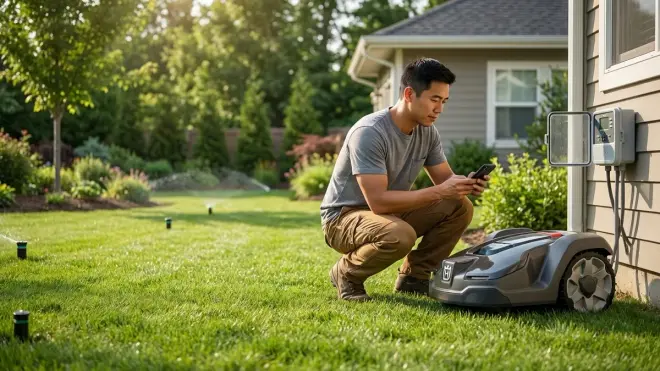
Yes, but the coordination quality depends heavily on which platforms your devices support. Basic coordination through voice assistant routines (Alexa, Google) lets you create simple time-based rules like "run irrigation at 6 AM, start mowing at 10 AM" to ensure grass is dry before mowing. Advanced coordination requires a hub like Home Assistant that can read sensor data and create conditional logic. For example, you could write automation that checks soil moisture sensors and skips mowing if the ground is wet, or that delays mowing for 3 hours after irrigation completes. The challenge is latency and reliability—because robotic mowers use cloud connectivity, your automations depend on internet uptime and cloud server responsiveness (typically 3-8 seconds for commands to execute). I've seen weather events that knock out internet service also break scheduled coordination between irrigation and mowing. The most reliable approach is to maintain conservative time buffers (4+ hours between irrigation and mowing) and enable the mower's built-in rain sensor as a backup safety mechanism.
What happens if my robotic mower loses GPS signal or boundary wire connection?
Fallback behavior varies by model and perimeter system—this is critical to understand before purchase because the consequences range from inconvenient to potentially damaging. Wire-based mowers have the most predictable failure mode: if boundary wire is cut or disconnected, the mower typically stops within 6-12 inches of detecting the break and displays an error code, then you repair the wire and resume. GPS-based mowers without reference stations (like the Segway Navimow) will continue operating using their last known boundary map when satellite signal degrades—they'll usually complete the current mowing session but may drift 6-12 inches outside intended boundaries if signal loss is extended. RTK GPS mowers with reference stations (like Husqvarna EPOS) handle temporary signal loss better—they use dead reckoning (calculating position based on speed and direction from the last known GPS fix) for up to 2-3 minutes, then return to dock if signal doesn't restore. Vision-based systems (EcoFlow Blade) rely on camera-detected edges and will stop if they can't visually identify lawn boundaries. The worst-case scenario is a GPS mower operating in an area with heavy tree cover or near tall buildings—I've seen units wander beyond intended boundaries when signal is intermittent, especially on properties with ambiguous transitions like lawn gradually fading into naturalized areas.
How do I integrate a robotic mower with my existing smart home energy management system?
Smart robotic mowers draw 50-150 watts while charging and negligible power while mowing (they run on battery), so they're minor consumers in your overall energy management strategy. The most valuable integration is charging schedule optimization if you're on time-of-use electricity rates. Using Home Assistant or a smart home hub that supports conditional automation, you can delay charging start times to off-peak hours. The logic looks like this: IF (current_time >= 22:00 AND mower_battery < 80%) THEN enable_charging() ELSE disable_charging(). This requires either a smart plug between the charging dock and your outlet (we recommend smart plugs with energy monitoring so you can verify consumption) or direct API control if the mower supports charging schedule programming. Most premium models (Husqvarna, Mammotion) let you set charging schedules through their apps without external smart plugs. The challenge is ensuring the mower has sufficient charge to complete scheduled mowing sessions—if you're too aggressive with off-peak-only charging and a hot week accelerates grass growth, you may need manual intervention to get the mower charged in time. I recommend programming energy management automations to allow emergency charging during peak hours if battery drops below 30%, with push notifications so you're aware of the override.
The Verdict
The best smart robotic lawn mowers for large yards require protocol awareness and realistic expectations about connectivity—you're investing in equipment that needs reliable Wi-Fi coverage or cellular connectivity across every square foot of your property, not just inside your house. If you have 1+ acres and complex terrain, the Husqvarna Automower 450X EPOS delivers the most reliable coverage with true wireless setup, though you'll pay for cellular subscription after the first year. For budget-conscious buyers willing to install boundary wire, the Worx Landroid Pro WR147E offers excellent value and the best smart home integration depth, especially if you're running Home Assistant and want local API control.
Remember that these are Wi-Fi or cellular devices, not Zigbee or Z-Wave components—your automations will depend on cloud connectivity, and you'll need to plan your network infrastructure accordingly. The learning curve is real, but once you've verified coverage and tuned your schedules, a properly configured robotic mower reclaims hours every week during growing season. For guidance on connecting robotic equipment to your smart home hub, see our integration guide.