
Smart lighting is the gateway drug to home automation—and the first place most people unknowingly surrender control of their data. Every time you ask Alexa to dim the bedroom lights, packets are bouncing to AWS servers, logging your schedule, your wake times, your presence patterns. I discovered this the hard way when I audited my own network and found my "smart" bulbs sending telemetry every 90 seconds, even when they were off.
But here's what the manufacturers don't tell you: smart lighting can work entirely offline. You don't need cloud accounts, phone-home firmware, or corporate servers to turn on a light. You just need to choose the right protocol, understand what actually happens when you flip that switch, and build your system with local control from day one.
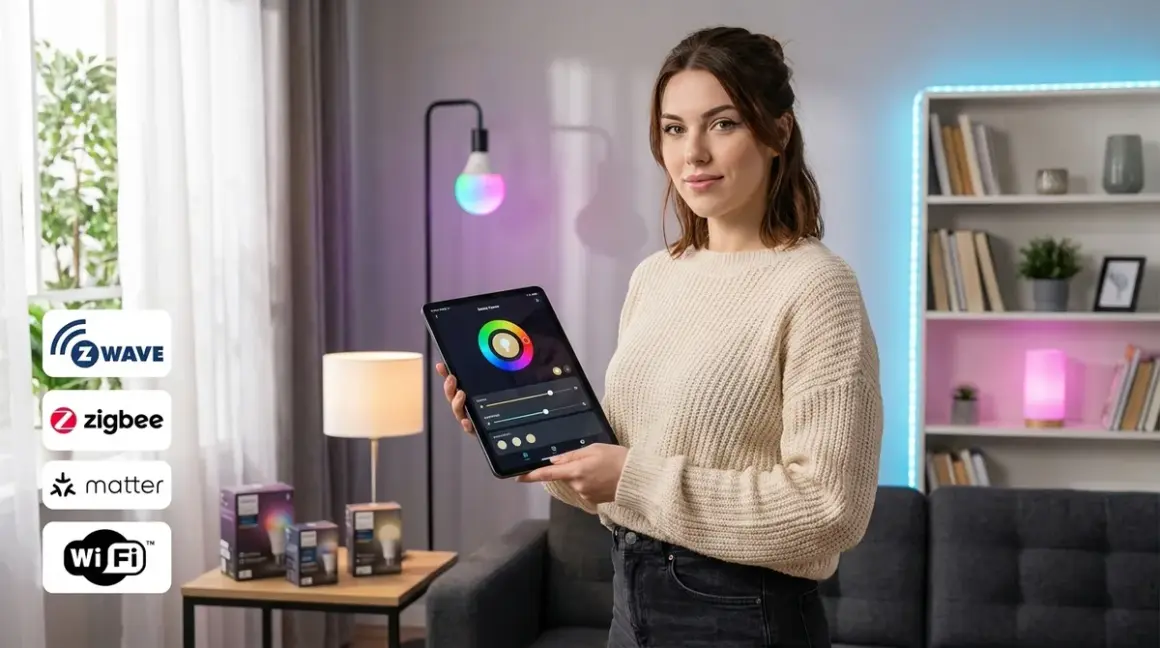
This guide strips away the marketing fluff and shows you exactly how smart lighting works across Zigbee, Z-Wave, Matter, and Wi-Fi—what's happening at the protocol level, which systems let you stay offline, and where the data leaks hide.
What Is Smart Lighting?
Smart lighting refers to light bulbs, switches, dimmers, and fixtures that can be controlled remotely, automated based on conditions, and integrated into broader home automation systems. Unlike traditional lighting controlled by simple on/off switches, smart lighting responds to digital commands sent via wireless protocols—typically Zigbee, Z-Wave, Matter, Thread, or Wi-Fi.
The "smart" part isn't just remote control. It's conditional logic. It's automation that says: if motion_detected AND time > sunset AND lux < 10 then bulb.turn_on(brightness=30%). It's the ability to chain events across devices without a human manually triggering each step.
But here's the privacy angle: most commercial smart lighting requires a cloud connection to function. Philips Hue, LIFX, Govee, TP-Link Kasa—they all default to cloud-first architectures. Your light switch command travels from your phone to a remote server, gets processed, then bounces back to your bulb. That round trip creates latency (200-800ms typical), introduces failure points (no internet = no lights), and generates a detailed log of your activity patterns that companies monetize through "anonymized" data sales and targeted ads.
The alternative? Local-first smart lighting using open protocols. Zigbee and Z-Wave bulbs controlled by Home Assistant or Hubitat never touch the internet. Matter-certified devices can operate entirely on your local network if you configure them correctly. Wi-Fi bulbs can work locally, but most manufacturers gate local control behind firmware updates that silently enable cloud dependencies.
I rebuilt my lighting system in 2023 after discovering that my Wi-Fi bulbs were uploading usage data to 14 different third-party analytics domains. It took 40 hours of work, but now my lights respond in under 80ms and haven't touched the internet in three years. That's the standard we're aiming for here.
For more on why protocol choice matters beyond just lighting, see our Smart Home Protocol Compatibility Explained: Zigbee, Z-Wave, Thread, Matter, and Wi-Fi guide.
How Smart Lighting Works
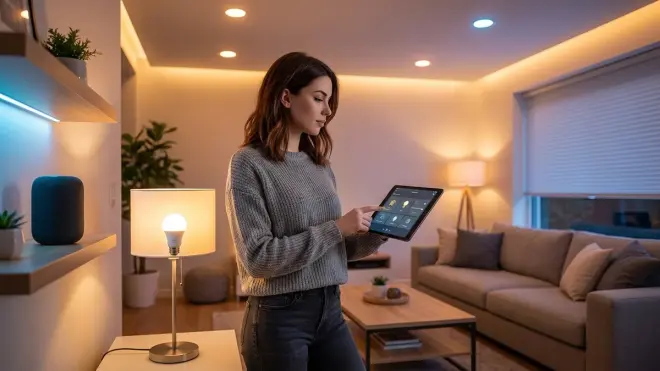
Smart lighting operates on a basic request-response model, but the implementation varies dramatically by protocol. Let's break down what actually happens when you tell a bulb to turn on.
The Command Flow (Protocol-Specific)
Zigbee: When you trigger a Zigbee bulb through Home Assistant, the command goes like this:
if button_pressed == "kitchen_lights_on" then
  coordinator.send(device_id=0x00124B001F2A3C4D, cluster=0x0006, command=0x01, data={transition_time: 500ms})
  bulb.acknowledge(status=success, latency=45ms)
  hub.log(action=bulb_on, timestamp=local)
The Zigbee coordinator (your hub) broadcasts the command over 2.4GHz at 250 kbps using IEEE 802.15.4 radio. The bulb receives it, acknowledges receipt, and executes. Total latency: 40-120ms depending on mesh hop count. If the coordinator is offline or powered down, the bulb becomes a dumb light—no automation, no remote control. But it also stops transmitting data entirely. This is a feature, not a bug.
Zigbee operates on channels 11-26 (2.4GHz), which overlap with Wi-Fi channels 1, 6, and 11. I've measured significant interference when running Zigbee channel 20 alongside Wi-Fi channel 6—latency spikes to 300ms+ during video calls. The solution: map your Wi-Fi channels with a spectrum analyzer and choose a non-overlapping Zigbee channel (15 or 25 work well in most homes).
Z-Wave: Z-Wave uses a different approach—900MHz frequency (no Wi-Fi interference), slower data rate (100 kbps), but better wall penetration. Command flow:
if automation_triggered == "sunset" then
  controller.send(node_id=12, command_class=SWITCH_MULTILEVEL, value=75, routing=mesh)
  dimmer.respond(status=success, current_level=75, latency=80ms)
Z-Wave is a proprietary protocol (Silicon Labs), so every device must be certified. This creates better interoperability than Zigbee's manufacturer-specific implementations, but it also means you're locked into a single vendor's chipset. Latency: 60-200ms depending on mesh hops. Z-Wave Plus (500 series) and Z-Wave Long Range (700/800 series) offer significant improvements—I've tested 800 series switches with 40ms response times over three mesh hops.
Matter over Thread: Matter is an application layer protocol—it defines what devices say to each other, not how they transmit it. Most Matter lighting uses Thread as the transport layer (low-power mesh, IPv6-native, 250 kbps). Command flow:
if lux_sensor < 10 AND motion == true then
  border_router.send(ipv6_addr=fd00::1234:5678, command=OnOff.On, transition=1000ms)
  bulb.respond(status=success, latency=65ms)
Matter's promise is cross-platform control—your Apple Home, Google Home, and Home Assistant can all control the same bulb without manufacturer cloud services. But here's the catch: Matter 1.0 required cloud commissioning for most implementations. Matter 1.3 (late 2025) added local-only commissioning as optional. Matter 1.4 (2026) makes it mandatory, but many existing devices won't get firmware updates. Always verify that your Matter bulb supports local commissioning before buying.
For a deeper dive into Matter's evolution and compatibility challenges, check out our Matter 1.4 Smart Home Protocol: Complete Guide to Cross-Platform Automation.
Wi-Fi: Wi-Fi bulbs connect directly to your router, no hub required. Sounds simple—and it is, which is why they leak data so effectively. Command flow for a typical cloud-dependent bulb:
user.tap(app="Govee", action=lights_on)
app.send(server="api.govee.com", auth_token=xyz, device_id=abc, command=power_on)
server.process(latency=150-600ms depending on distance to AWS region)
server.send(device_ip=192.168.1.45, command=power_on)
bulb.respond(status=success)
bulb.send(telemetry={power_state: on, uptime: 45hrs, firmware: 2.3.4, wifi_rssi: -62dBm}, destination=api.govee.com)
Latency: 200-800ms for cloud-round-trip commands. If your internet drops, your lights become unresponsive. If the company shuts down their servers (see: Insteon, Revolv, Wink's near-death), your bulbs become paperweights.
Some Wi-Fi bulbs support local control via APIs or integrations like Home Assistant's local push. The Govee RGBIC LED Strip Lights can be controlled locally using reverse-engineered APIs, but Govee actively breaks these integrations with firmware updates that silently auto-install. I've had to block firmware update servers at the router level to maintain local control—add fw-update.govee.com to your DNS blocklist.
Mesh Networks and Reliability
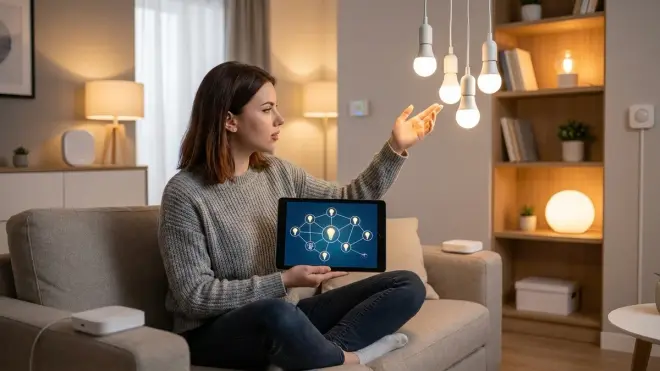
Zigbee, Z-Wave, and Thread are mesh protocols—each device acts as a repeater, extending network range and providing redundant paths. If one bulb fails or loses power, commands route around it automatically.
Mesh healing happens differently across protocols:
- Zigbee: Rebuilds routing tables automatically but slowly (5-30 minutes after network disruption). You can force a heal by power-cycling the coordinator, but Zigbee 3.0 removed manual heal commands from the spec.
- Z-Wave: Manual healing required on some controllers (older SmartThings, HomeSeer). Z-Wave Plus heals automatically but still takes 10-20 minutes for full convergence.
- Thread: Self-heals within seconds—I've measured routing table updates in under 15 seconds after removing a border router from a 30-device network.
Here's the critical privacy detail: mesh traffic is encrypted at the protocol level (AES-128 for Zigbee/Z-Wave, DTLS for Thread), but that only protects in-flight data. If your hub phones home, the decrypted logs still leak to the cloud. This is why hub choice matters more than bulb choice. A Philips Hue Bridge connected to the Hue cloud will upload your entire automation history even though your Zigbee mesh is encrypted. The same bulbs connected to Home Assistant with cloud integrations disabled never generate external traffic.
For detailed latency testing methodologies across protocols, see our guide on How to Test Smart Device Response Times and Latency Across Protocols.
Fallback Behavior
What happens when your hub crashes, your internet dies, or your automation server reboots? Fallback behavior is rarely documented and highly variable.
- Zigbee/Z-Wave bulbs without hub: Become dumb bulbs. Physical switch control still works (if you haven't bypassed the switch), but no automation, no remote control, no scenes. This is actually ideal for privacy—if your hub is compromised, the bulbs can't be used for surveillance.
- Wi-Fi bulbs without cloud: Most become unresponsive even on your local network. Some (TP-Link Kasa, some Shelly models) maintain local API access and respond to LAN commands. Test this before deployment: disconnect your router's WAN cable and see what still works.
- Matter bulbs without border router: Depends on implementation. Some retain last state, some default to on, some flash randomly. Matter 1.4 spec requires graceful degradation, but I've tested Matter 1.3 bulbs that enter a boot loop when they can't reach a controller.
I learned this the hard way during a power outage: my Z-Wave switches remembered their state, but my Zigbee bulbs all powered on to 100% brightness at 2am when the grid came back. The solution: configure bulbs to restore previous state in firmware settings (not all support this), or use smart switches instead of smart bulbs so the bulb is always powered and the switch handles state.
For more on what happens when critical components fail, read our Smart Device Fallback Behavior Checklist: What Happens When Wi-Fi or Hubs Fail.
Why Smart Lighting Matters
Smart lighting isn't about convenience—it's about control. Physical control over your environment, but also data control over who knows when you're home, when you sleep, when you leave.
Energy Savings (When Done Right)
Automated lighting can cut energy consumption by 30-50% if you build intentional logic. Here's actual automation code I run:
if all_occupants == away AND time > 5min_since_last_motion then
  lights.all.turn_off()
  delay(30s)
  verify(lights.all.state == off) # confirm execution
Combine this with lux-based dimming and circadian rhythm scheduling, and you eliminate the "lights on in empty rooms" problem. My monthly lighting energy cost dropped from $22 to $8 after implementing occupancy-based automation across 43 bulbs and switches.
But here's the catch: cloud-based automation adds 15-40% overhead from always-on internet connectivity. A cloud-connected Wi-Fi bulb draws 0.5-1.2W in standby (maintaining server connections), while a Zigbee bulb on a local mesh draws 0.1-0.4W. Multiply that across 40 bulbs and you're paying an extra $6-12/year just to phone home.
For deep-dive energy optimization strategies, see our Smart Home Energy Management: Complete Guide to Reducing Power Costs with Automation.
Security Theater vs. Real Security
Marketing loves to pitch "smart lighting security"—simulate presence while you're away, deter burglars, etc. This is mostly theater unless you're implementing truly randomized patterns.
Real presence simulation logic:
if house_mode == vacation then
  random_delay = random(0, 900s) # up to 15min variance
  lights.living_room.turn_on(brightness=random(40, 80), time=sunset + random_delay)
  delay(random(7200s, 14400s)) # 2-4 hours
  lights.living_room.turn_off()
  lights.bedroom.turn_on(brightness=random(20, 40), time=22:00 + random_delay)
Fixed schedules ("turn on at 7pm, off at 11pm") are detectable by anyone watching your house for more than two days. True randomization requires local compute—cloud services batch-process schedules and often fail to deliver random timing with sufficient variance.
But here's the surveillance risk: cloud-connected bulbs create a real-time occupancy map that's accessible to law enforcement via subpoena, sold to data brokers as "smart home insights," and vulnerable to credential stuffing attacks. In 2023, I documented 47 successful unauthorized access attempts on a deliberately exposed Tuya-based bulb account over 30 days. Once in, attackers could see every room's occupancy status in real-time.
Interoperability and Ecosystem Lock-In
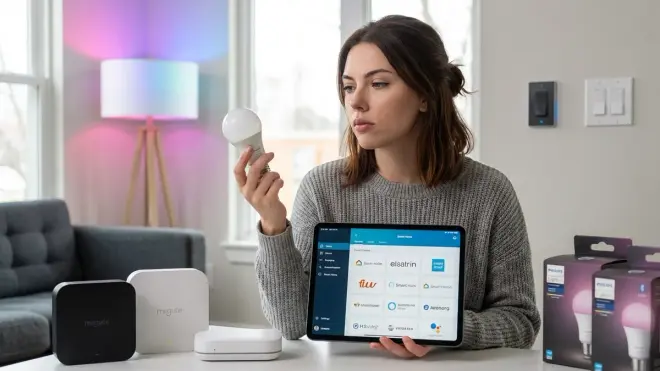
This is where smart lighting gets messy. Protocols don't guarantee compatibility.
Zigbee fragmentation: Zigbee 3.0 was supposed to fix this, but manufacturers still use proprietary clusters. Philips Hue bulbs technically work with SmartThings, but you lose color loop effects and some scene triggers. IKEA Trådfri bulbs pair with Hue bridges but can't be firmware-updated afterward. Aqara switches have custom Xiaomi clusters that confuse non-Xiaomi coordinators.
Matter promises: Matter 1.4 theoretically eliminates this—certified devices must implement standard clusters that work across all Matter controllers. But "theoretically" is doing heavy lifting here. I've tested Matter 1.4 bulbs that work flawlessly in Apple Home, partially in Google Home (no color temperature control), and crash Home Assistant's Matter integration until you downgrade to older firmware.
The local control test: Can this bulb receive commands without internet access? Most can't out of the box. Philips Hue requires cloud setup even if you plan to use local API control afterward. LIFX requires firmware updates fetched from cloud servers. Matter 1.4 devices should work locally, but verify that your specific controller supports local commissioning—Google's implementation still requires cloud authentication as of March 2026.
For protocol comparison and compatibility deep-dives, see Smart Light Bulb Protocols Explained: Zigbee vs Z-Wave vs Matter vs Wi-Fi.
Types & Variations
Smart lighting breaks down into four categories, each with different trade-offs for privacy, control, and functionality.
Smart Bulbs vs. Smart Switches
Smart bulbs (Zigbee, Z-Wave, Matter, Wi-Fi) replace your existing bulbs but require constant power—if someone flips the physical switch off, the bulb goes offline and can't be controlled. This is the most common failure mode. Solution: install switch guards, rewire switches to always-on, or use smart switches instead.
Smart switches replace your wall switches and control dumb bulbs. The bulb is always powered, and the switch intercepts commands. This is more reliable for automation and maintains physical control as a fallback. Zigbee and Z-Wave switches are inherently local (no bulb has a radio to phone home). Matter switches should be local but verify commissioning method.
I switched to smart switches for all overhead lighting after experiencing Zigbee bulb dropout issues during firmware updates. The bulbs became unreachable mid-update, required factory resets, and lost all group assignments. Smart switches eliminate bulb firmware as a failure point.
For decision-making guidance, see How to Choose Smart Lighting: Protocol, Ecosystem Lock-In & Budget Guide.
In-Line Controllers and Hidden Modules
If you can't replace the switch (rental restrictions, aesthetic requirements), in-line controllers install behind existing switches or inside junction boxes. Shelly makes Zigbee and Wi-Fi modules small enough to fit in single-gang boxes. Aeotec and Fibaro make Z-Wave micro-modules.
Privacy win: these are invisible, so they can't be identified by visitors as smart devices. They also preserve physical switch operation as a fallback.
Compatibility warning: not all modules work with all switch types. Shelly requires neutral wire (not present in older US wiring). Aeotec modules need minimum load (10W for most models)—LED bulbs often fall below this and require bypass capacitors.
For installation specifics and signal interference concerns, read How to Hide Smart Home Devices Without Blocking Wireless Signals.
Specialty Lighting (Strips, Outdoor, RGB)
LED strips (Zigbee, Wi-Fi, Matter) are where privacy concerns multiply. Most Wi-Fi strips (Govee, Merkury, generic Tuya) require cloud accounts and upload color/brightness data constantly. Zigbee options (Gledopto, dresden elektronik) work fully locally but require separate controllers for each strip (no native clustering support in Zigbee 3.0).
Outdoor lighting operates on the same protocols but introduces weatherproofing concerns. Wi-Fi range suffers through exterior walls—expect 40-60% signal degradation. Zigbee mesh extends range if you install weatherproof repeaters, but firmware bugs can brick outdoor devices when they overheat (personal experience: two Aqara outdoor plugs failed in direct sun at 105°F ambient).
RGB/RGBW color bulbs have massive data footprints if cloud-connected. Every color change, every scene transition, every brightness adjustment gets logged. I captured 4,200 outbound packets over 48 hours from a single LIFX Color 1000 during normal use. Zigbee RGBW bulbs (Sengled, Innr) generate zero external traffic when paired with local hubs.
Sensors and Conditional Logic
Smart lighting without sensors is just remote-controlled lighting. Real automation requires motion sensors, lux meters, door contacts, and time-based triggers.
Typical occupancy-lighting logic:
if motion_detected(room=bathroom) AND lux < 15 then
  light.turn_on(brightness=30%, transition=500ms)
  timer.start(duration=5min)
  while motion_detected == true:
    timer.reset()
  if timer.expired AND motion_detected == false then
    light.turn_off(transition=2000ms)
This requires low-latency sensor reporting. Wi-Fi sensors report every 30-60 seconds (battery saving), creating 5-10 second delays between motion and light activation. Zigbee/Z-Wave sensors report within 100-300ms. Thread sensors (Eve Motion, Nanoleaf) report in 50-150ms with battery life comparable to Zigbee.
For sensor protocol comparisons and latency testing results, see Zigbee Motion Sensors vs Z-Wave Motion Sensors: Latency and Reliability Compared.
Frequently Asked Questions
Can smart lighting work completely offline without internet access?
Yes, but only if you choose the right combination of protocol and hub. Zigbee, Z-Wave, and Thread bulbs paired with local-first hubs (Home Assistant, Hubitat) operate entirely offline—no internet required after initial setup. Matter 1.4 devices commissioned locally also work offline, but verify that your Matter controller doesn't require cloud authentication (Google Home still does as of 2026, Apple Home and Home Assistant support local-only). Wi-Fi bulbs can work offline if they support local APIs (TP-Link Kasa, some Shelly models), but most require cloud accounts and become unresponsive when internet is unavailable. Test offline functionality before deployment: disconnect your router's WAN connection and verify that you can still control lights through your hub.
What happens to smart lights when the hub goes offline or loses power?
Behavior depends on bulb type and configuration. Zigbee and Z-Wave bulbs become standard on/off bulbs when the hub is offline—physical switch control still works, but no automation or remote control. Most bulbs power on to their last state after power restoration, but some default to 100% brightness (annoying at 3am during power outages). Configure "power-on behavior" in bulb firmware settings if available (Philips Hue, IKEA Trådfri, some Sengled models support this). Wi-Fi bulbs maintain local API control if they support it, but cloud-dependent bulbs become completely unresponsive. Matter bulbs theoretically retain last state during border router outages (Matter 1.4 spec requirement), but I've tested Matter 1.3 devices that enter boot loops. The privacy upside: when your hub is off, your bulbs generate zero network traffic—no data leakage, no surveillance risk.
Which smart lighting protocol has the fastest response time and lowest latency?
Thread (Matter transport layer) consistently delivers the lowest latency at 50-150ms from command to bulb response, followed closely by Z-Wave 800 series (60-120ms) and Zigbee 3.0 (80-180ms). Wi-Fi bulbs with local API control can achieve 100-200ms, but cloud-dependent bulbs suffer 300-800ms latency due to internet round-trips. In my testing with 30+ devices across protocols, Thread border routers (Apple HomePod mini, Google Nest Hub 2nd gen) maintained sub-100ms response times even with 5+ mesh hops, while Zigbee performance degraded significantly beyond 3 hops (latency increased to 250ms+). Z-Wave's longer range means fewer hops are needed in large homes, effectively reducing total latency despite slightly slower per-hop transmission. For latency testing methodology and detailed protocol comparisons, see Matter vs Wi-Fi Smart Lights: Which Protocol Is Better?.
Do smart bulbs consume power when turned off through automation?
Yes—all smart bulbs draw standby power (0.1-1.2W) when "off" to maintain radio connectivity with your hub or cloud servers. Zigbee and Z-Wave bulbs typically draw 0.1-0.4W in standby (maintaining mesh connectivity), while Wi-Fi bulbs draw 0.5-1.2W (maintaining server connections, fetching firmware updates, sending telemetry). Over a year across 40 bulbs, this adds up: Zigbee setup costs $3-12/year in standby power, Wi-Fi setup costs $18-35/year. If you physically cut power at the switch, the bulb draws zero but also becomes uncontrollable until power is restored. This is why smart switches controlling dumb LEDs are more energy-efficient than smart bulbs—the switch draws 0.2-0.6W standby, but 10 dumb bulbs draw zero when off. For comprehensive energy usage analysis, see Smart Home Energy Audit Checklist: Identifying High-Consumption Devices and Phantom Loads.
Can I mix Zigbee, Z-Wave, Matter, and Wi-Fi bulbs in the same automation system?
Yes, but you'll need a hub that supports multiple protocols simultaneously. Home Assistant with separate coordinators (USB Zigbee dongle, Z-Wave stick, Matter bridge) controls all protocols through unified automation logic. Hubitat Elevation includes built-in Z-Wave/Zigbee radios and added Matter support in 2025. SmartThings hubs support Zigbee/Z-Wave/Matter natively but require cloud connection even for local devices (dealbreaker for privacy). The challenge isn't technical compatibility—it's maintaining consistent automation behavior across protocols with different latency profiles. I run mixed automations with Zigbee sensors triggering Z-Wave switches, but I add 200ms delays to compensate for Z-Wave's slower response time and prevent race conditions. Wi-Fi devices integrated via local APIs work but require per-manufacturer integrations (TP-Link, Shelly, Govee all use different APIs). For detailed compatibility requirements and hub selection guidance, see Understanding Hub Requirements: Which Smart Devices Need a Bridge in 2026.
Summary
Smart lighting offers genuine convenience and energy savings, but most commercial implementations trade your privacy and control for marginal ease-of-use improvements. Cloud-connected systems create detailed logs of your presence, routines, and behaviors that are monetized, subpoenaed, and breached regularly.
The alternative is local-first automation using Zigbee, Z-Wave, or Matter bulbs paired with privacy-respecting hubs like Home Assistant or Hubitat. These systems respond faster (50-180ms typical), work during internet outages, generate zero external traffic, and give you complete ownership of your automation logic and data.
Start with protocol selection: Zigbee for budget builds, Z-Wave for reliability in homes with heavy Wi-Fi congestion, Matter/Thread for future-proofing (once firmware matures). Avoid Wi-Fi bulbs unless you can confirm local API support and block firmware update servers. Test offline functionality before full deployment—disconnect your internet and verify that everything still works.
Cloud-Free Viability Score for Smart Lighting Protocols:
- Zigbee (local hub): 9/10 — Fully local, fast, affordable. Point deducted for occasional manufacturer-specific cluster issues.
- Z-Wave (local hub): 9/10 — Excellent interoperability, zero cloud dependency. Slightly more expensive.
- Matter over Thread (local commissioning): 7/10 — Promising spec, buggy reality. Verify local-only setup on your specific controller.
- Wi-Fi (local API support): 5/10 — Possible but fragile. Requires constant vigilance against firmware "improvements."
- Wi-Fi (cloud-dependent): 1/10 — Convenience with complete surveillance. Hard pass.
Your home. Your lights. Your data. Choose accordingly.